example fiducial marker patterns#
This page contains example fiducial marker patterns for different cameras that have acquired historical aerial photos,
including what their fiducial marks look like, and the approximate coordinates of the fiducial marks that you can use
to populate the MeasuresCamera.xml file.
Note
The fiducial markers in the following examples are labeled as follows, with the assumption that the data strip / direction of flight marker is on the left side of the image:
P1: the lower left corner of the image
P2: the upper right corner of the image
P3: the upper left corner of the image
P4: the lower right corner of the image
P5: the middle of the left edge image
P6: the middle of the right edge of the image
P7: the middle of the top edge of the image
P8: the middle of the bottom edge of the image
a note on identification#
Aside from a single 1960 article[1], I have not managed to find much solid information about different fiducial marker patterns used by different camera manufacturers in different cameras. Some patterns are relatively distinct, but others are both very similar and widely used, making a definitive identification based on the fiducial pattern alone challenging, especially for earlier cameras that did not expose this ancillary information on the image negative.
A good deal of the information on this page has been pieced together from looking at a very large number of images and calibration reports downloaded from EarthExplorer[2] and the USGS Camera Calibration Report Database. This guide is by no means exhaustive, though it is built on a fairly large dataset of example images.
Note
If you have a calibration report that corresponds to your specific images, you should use that instead.
The information provided here is for those cases where a calibration report does not exist, or has been lost to time.
Tip
For images acquired by the US Government or other agencies and hosted on EarthExplorer, you may be able to find a calibration report by using the lens or camera serial number, if this was recorded on the camera’s data strip (or, sometimes, written around the edges of the frame).
With the serial number(s) and/or other identifying information (e.g., make/model), you can use the USGS Camera Calibration Report Database to search for the calibration report for your camera (or a similar camera).
Additionally, I have transcribed the information from a (growing) number of these calibration reports; the combined CSV files and a few jupyter notebooks for printing summary information based on make/model, fiducial marker pattern, etc. can be found at iamdonovan/fiducial_markers.
“wing-type” fiducials#
A number of different camera manufacturers have used four “wing-shaped” mid-side fiducial markers of varying designs:
Aero Service Corporation (also Aero/View cameras, or just “Aero”)
Airagon
Mark Hurd Aerial Surveys, Inc.
Park Aerial Surveys, Inc.
Fairchild
Wes Smith
Many of the cameras made/used by Mark Hurd Aerial Surveys, Inc., Park Aerial Surveys, Inc., or similar companies do not appear to have model names - rather, they are identified only by a number. The lenses used in these cameras tend to be made by manufacturers such as Bausch and Lomb (e.g., the Metrogon Lens), C. P. Goerz (e.g., the Aerotar lens), or Zeiss (e.g., the Pleogon lens).
Tip
Because:
the measured separation between P5-P6 and P7-P8 is somewhat variable for these images, even for the same camera manufacturer (and sometimes even the same camera as identified by the serial number…); and
the majority of these cameras were used before coordinates were regularly included in calibration reports,
it is probably a better idea to use estimate_measures_camera
with a large sample of these images (and the known scanning resolution), rather than the approximate coordinates
given below.
hollow-type wing#
Cameras with this style of fiducial marker (four mid-side ‘wing’ markers that are at least semi-transparent) seem to have been made by Mark Hurd Aerial Surveys, Inc. They do not have any particular model name, and are recorded with single- or double-digit serial numbers in most calibration reports on file. They used a few different lens types, mostly Bausch and Lomb Metrogon with a 6” (152 mm) focal length.
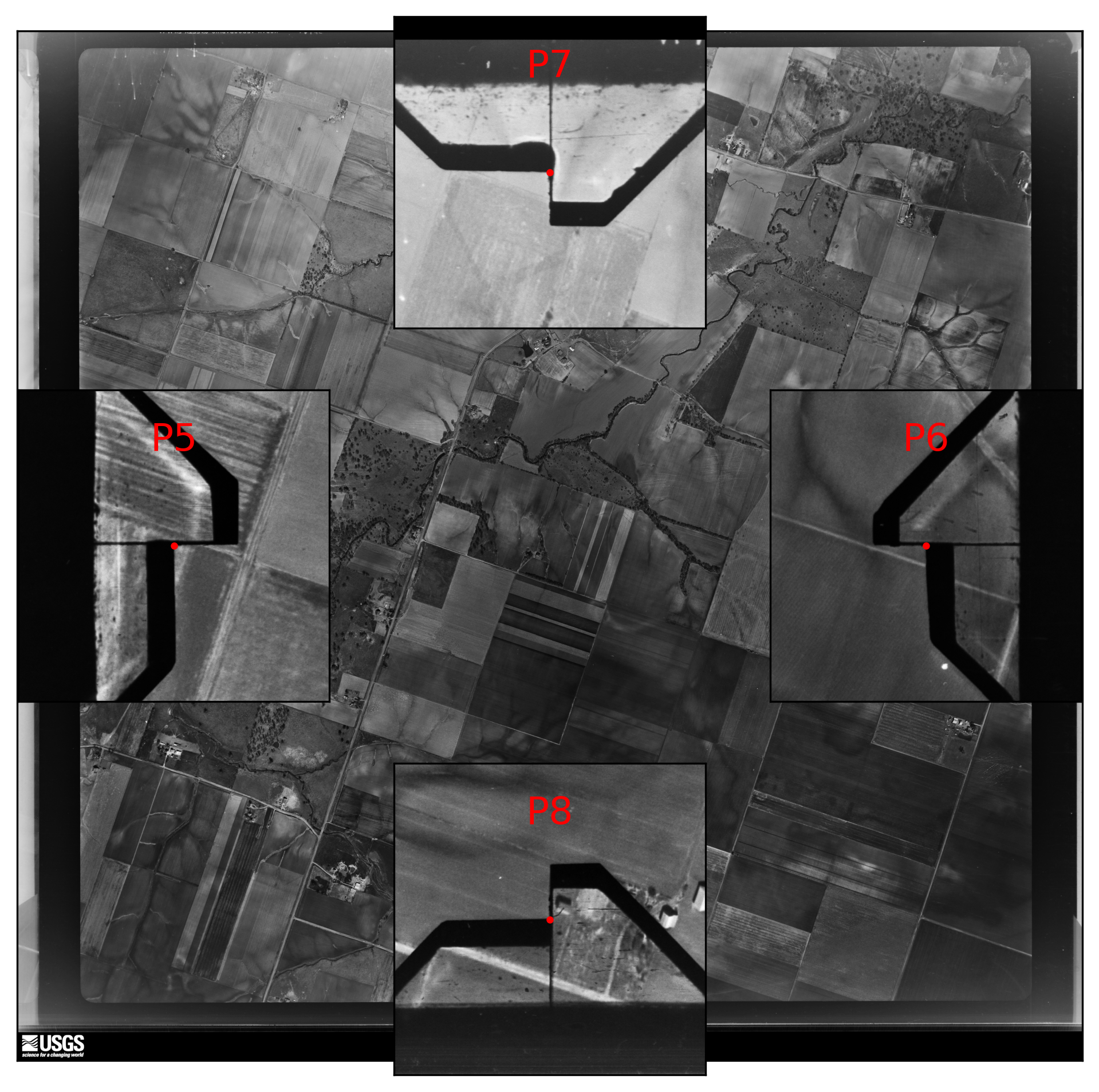
Marker Separation (n = 3 reports)
markers |
mean |
median |
|---|---|---|
P5 - P6 |
221.887 ± 0.097 |
221.91 |
P7 - P8 |
221.780 ± 0.070 |
221.78 |
flat wing (small)#
This style is perhaps the most common of the wing-type (at least by volume in EarthExplorer), and seems to have been used by a wide range of manufacturers (with the caveat noted above[2]):
Fairchild (K-3B “modified”, K-17, K-17 “modified”, K-17B “modified”)[3]
Aero Services (Aero, Aero/View)
Airagon
Western Aerial Contractors
Park (Twinplex, unnamed)
Some, but not all, of these used a direction of flight indicator similar to the one shown below on P5. Some models also had early data strip styles, with both serial number and calibrated focal length included in the image (the example below, from a Park camera, has these on the left side of the frame).
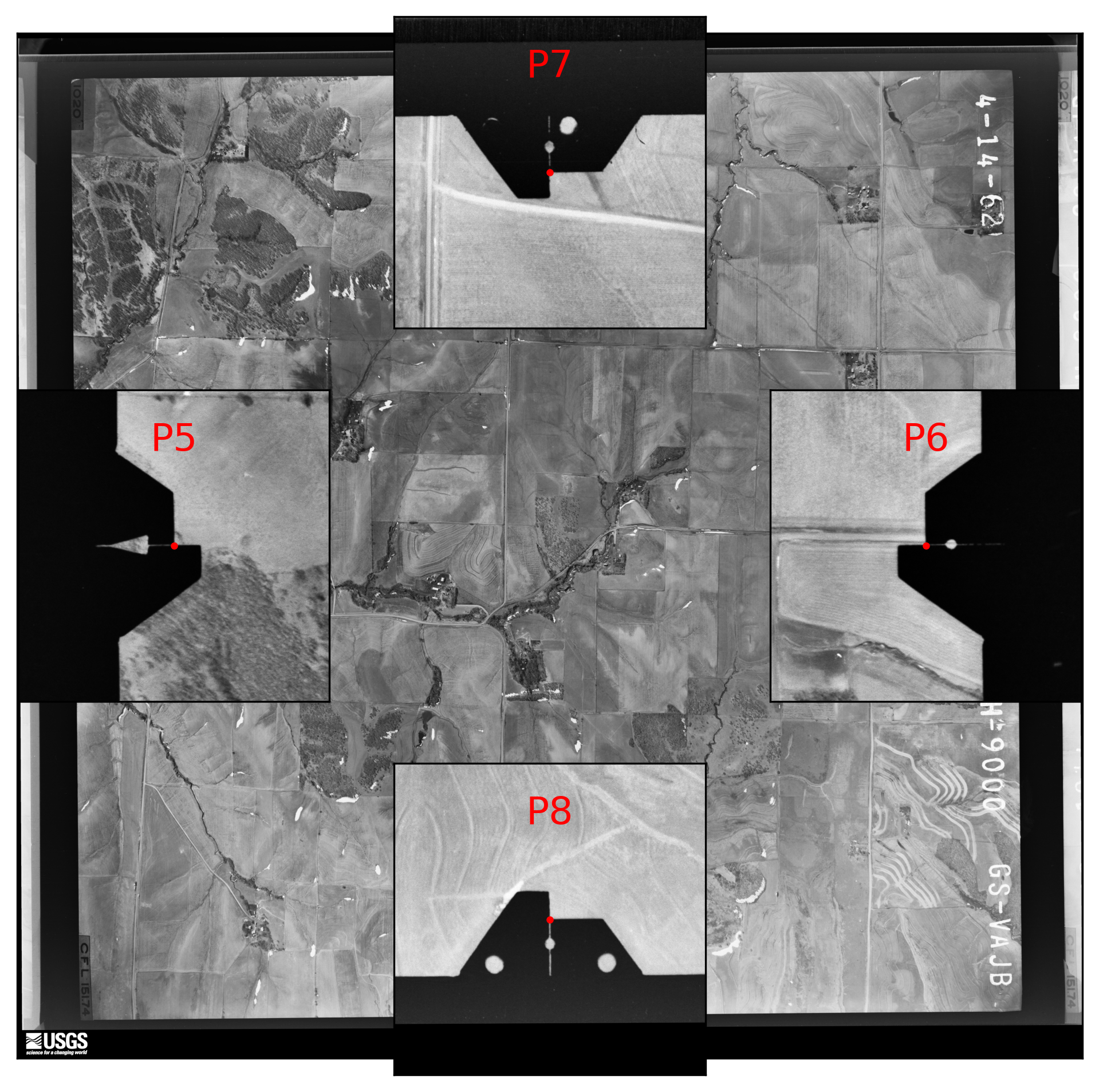
Marker Separation (n = 120 reports)
markers |
mean |
median |
|---|---|---|
P5 - P6 |
222.698 ± 0.489 |
222.49 |
P7 - P8 |
222.773 ± 0.659 |
222.495 |
flat wing (large)#
A larger version of the “flat” wing was used in at least the Fairchild F-224 and K-17A cameras. In the lower-right corner of the frame, there is sometimes an indicator with the focal length (when not overwritten by other markings on the print, that is).
Note also the diamond-shaped marker on P5, which I am taking to be the “direction of flight marker” as the arrow-shaped notches on both P5 and P6 point in opposing directions.
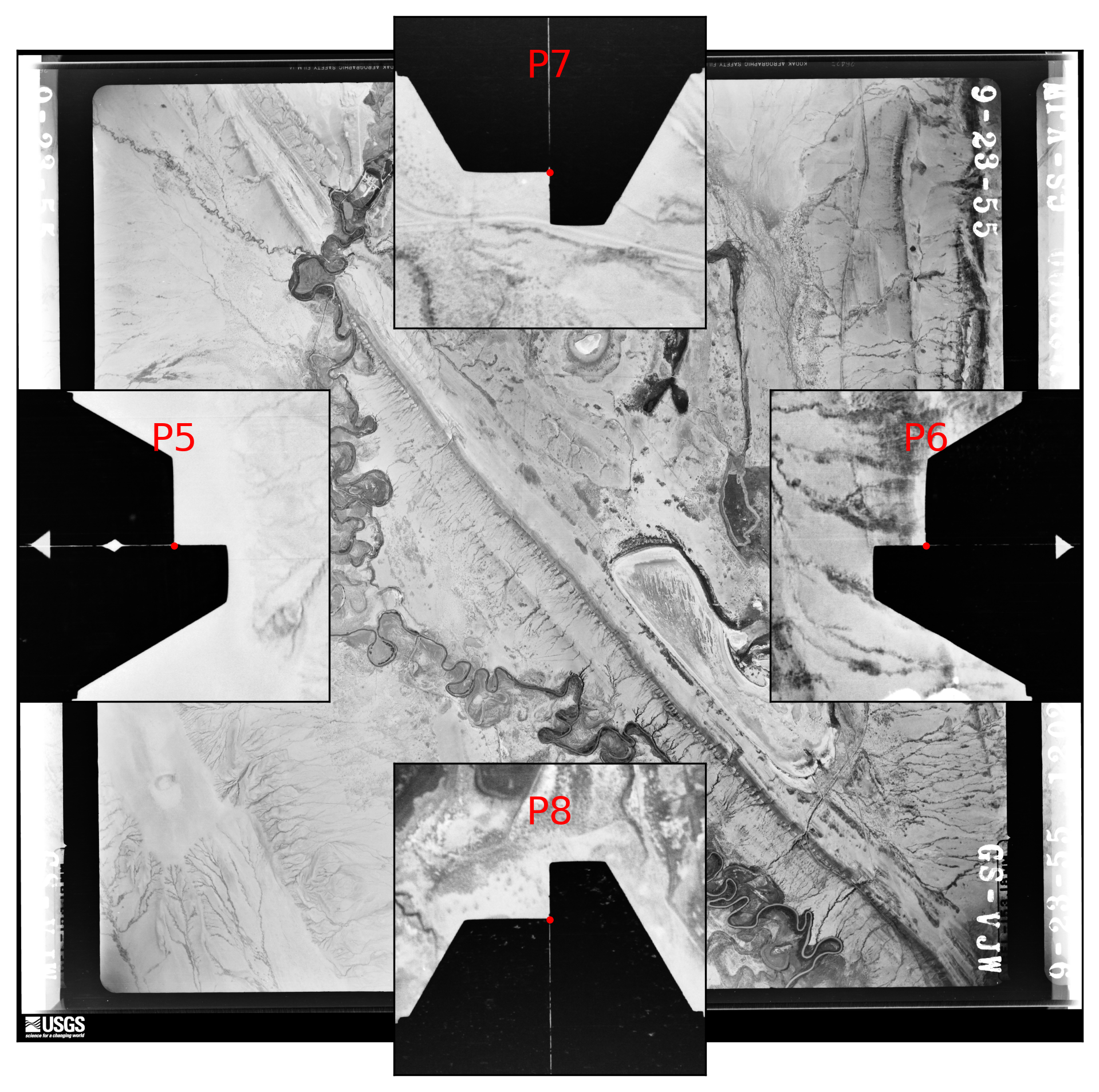
Marker Separation (n = 1 reports)
markers |
mean |
median |
|---|---|---|
P5 - P6 |
217.490 ± nan |
217.49 |
P7 - P8 |
217.510 ± nan |
217.51 |
flat wing (tall)#
A “tall” version of the “flat” wing was used in primarily Aero Services (also labeled as Aero, Aero/View) cameras. Some versions of these cameras have a small marker that includes the camera number on it, usually just below P5. Note also the diamond-shaped marker on P5, which I am taking to be the “direction of flight marker”.
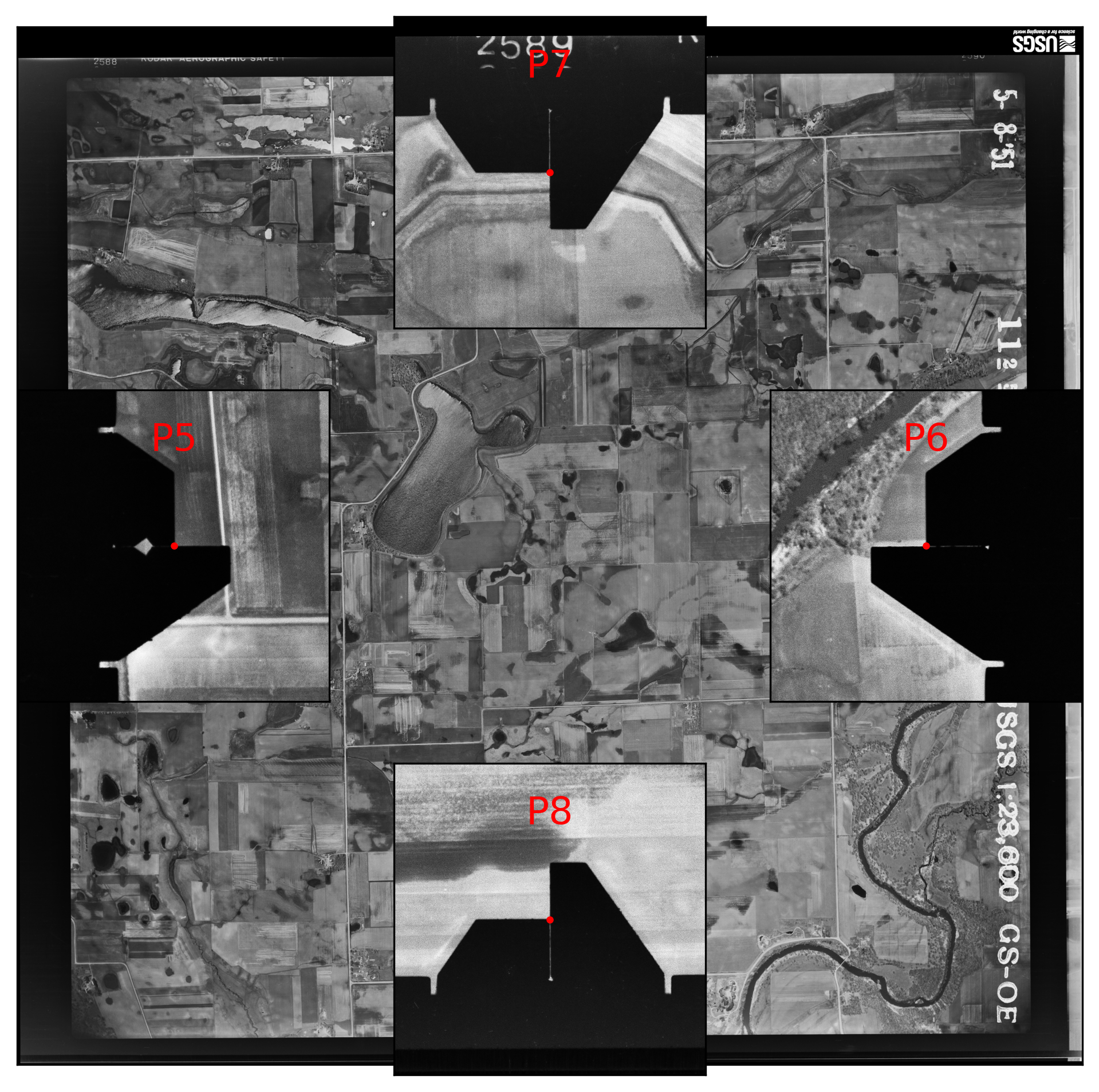
Marker Separation (n = 5 reports)
markers |
mean |
median |
|---|---|---|
P5 - P6 |
222.596 ± 0.984 |
222.41 |
P7 - P8 |
223.010 ± 0.557 |
223.02 |
flat wing (curved)#
This design was used primarily in cameras manufactured by Wes Smith (or just “Smith”). Note that marker P5 in the example below has a “direction of flight” indicator, meant to point in the direction that the plane was flying (in this case, towards the right of the frame):
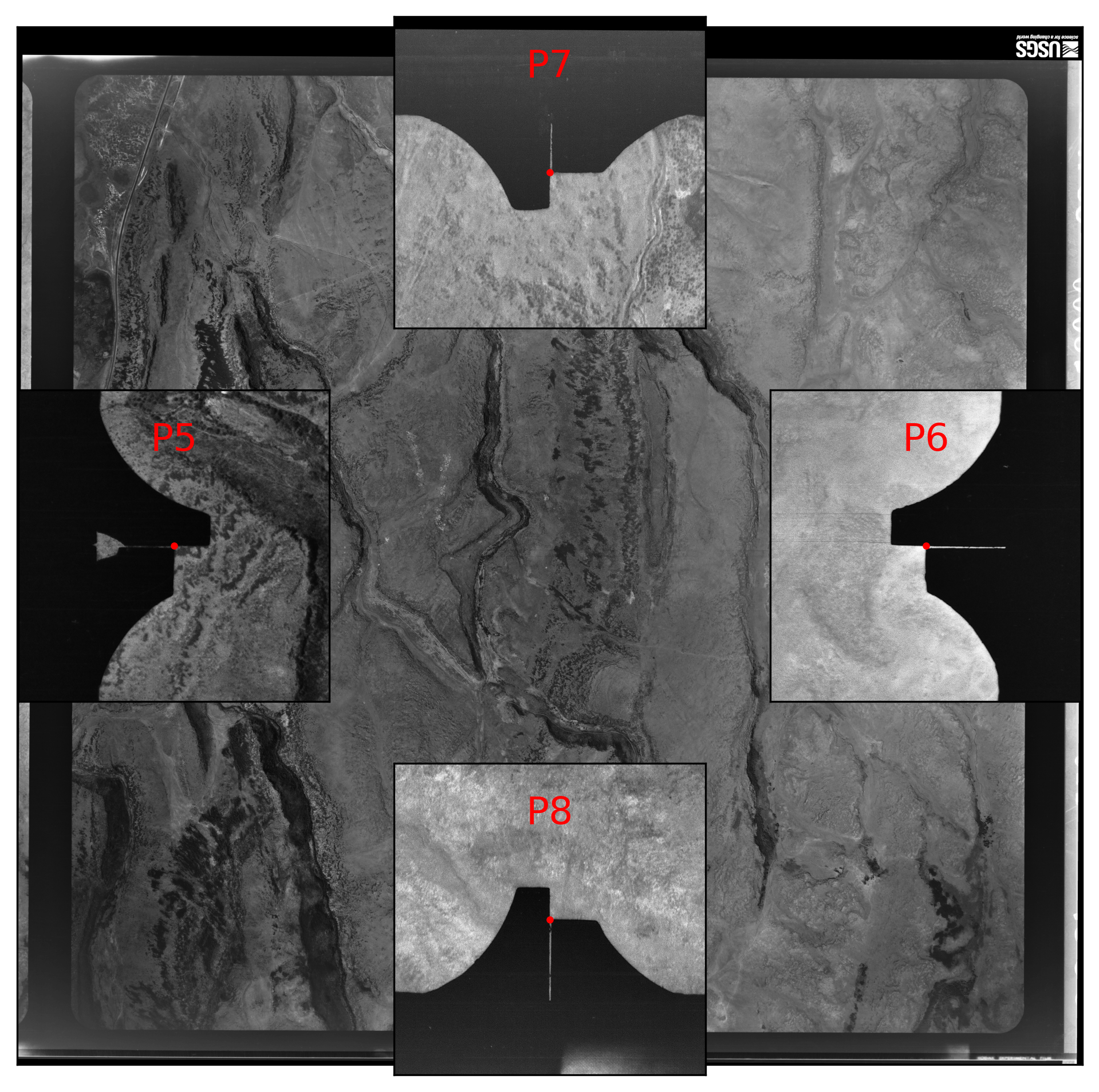
Marker Separation (n = 6 reports)
markers |
mean |
median |
|---|---|---|
P5 - P6 |
221.322 ± 1.038 |
221.51 |
P7 - P8 |
221.598 ± 1.423 |
222.055 |
curved wing#
This design was used in at least some versions of the K-17 “modified” camera. Note that three of the markers have notches on either side, or are slightly inset from the rest of the frame - in the absence of any other identifying marks, I am taking P5 to be the odd one out.
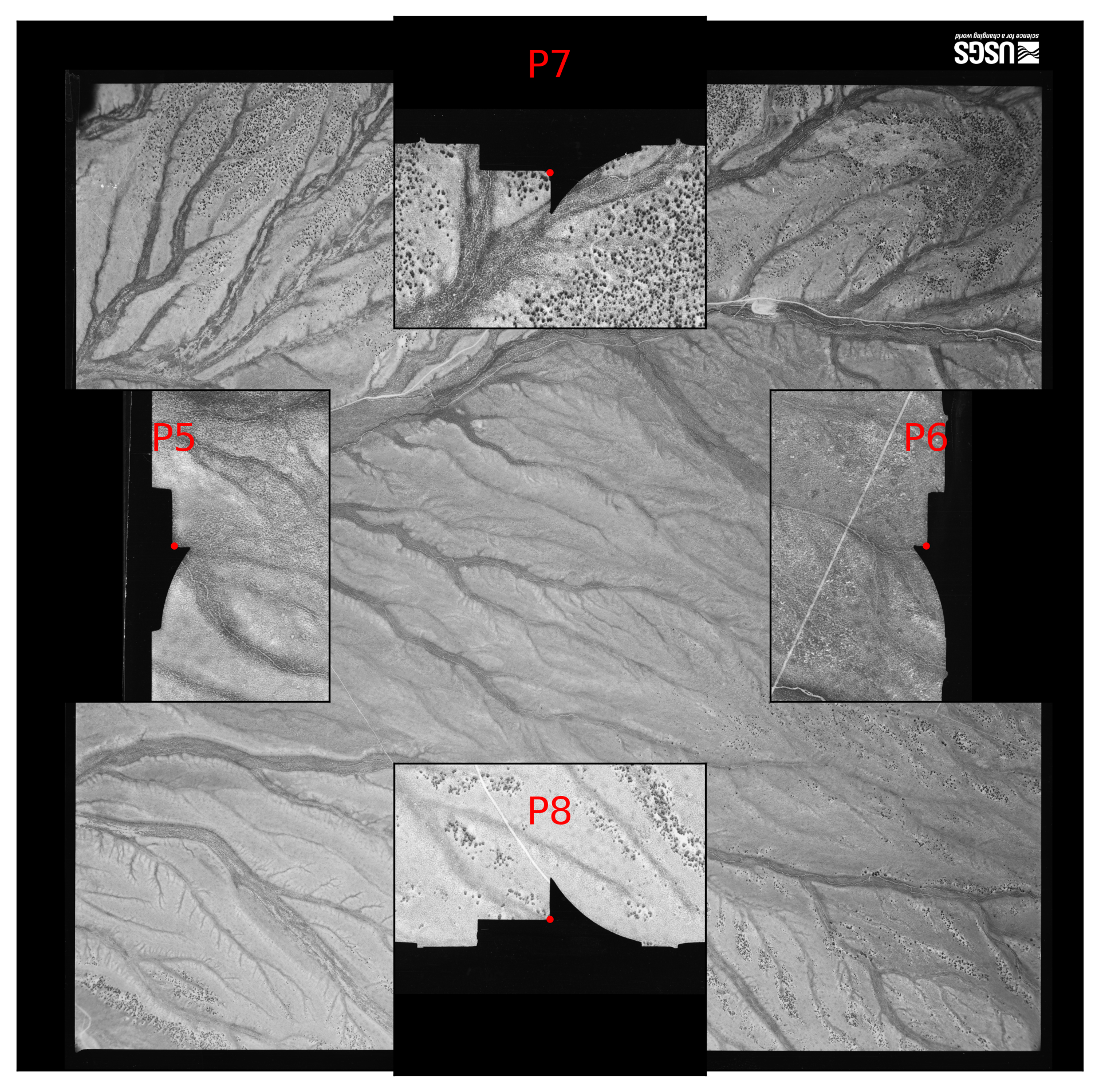
Marker Separation (n = 4 reports)
markers |
mean |
median |
|---|---|---|
P5 - P6 |
222.295 ± 0.135 |
222.345 |
P7 - P8 |
222.330 ± 0.076 |
222.355 |
sharp wing#
This design was used in at least the Fairchild K-17 and some “modified” versions of the K-17 camera. As with the F-224 and K-17B cameras, there is a strip indicating the calibrated focal length in the lower right-hand corner of the frame, as well as a “direction of flight” marker on P5:
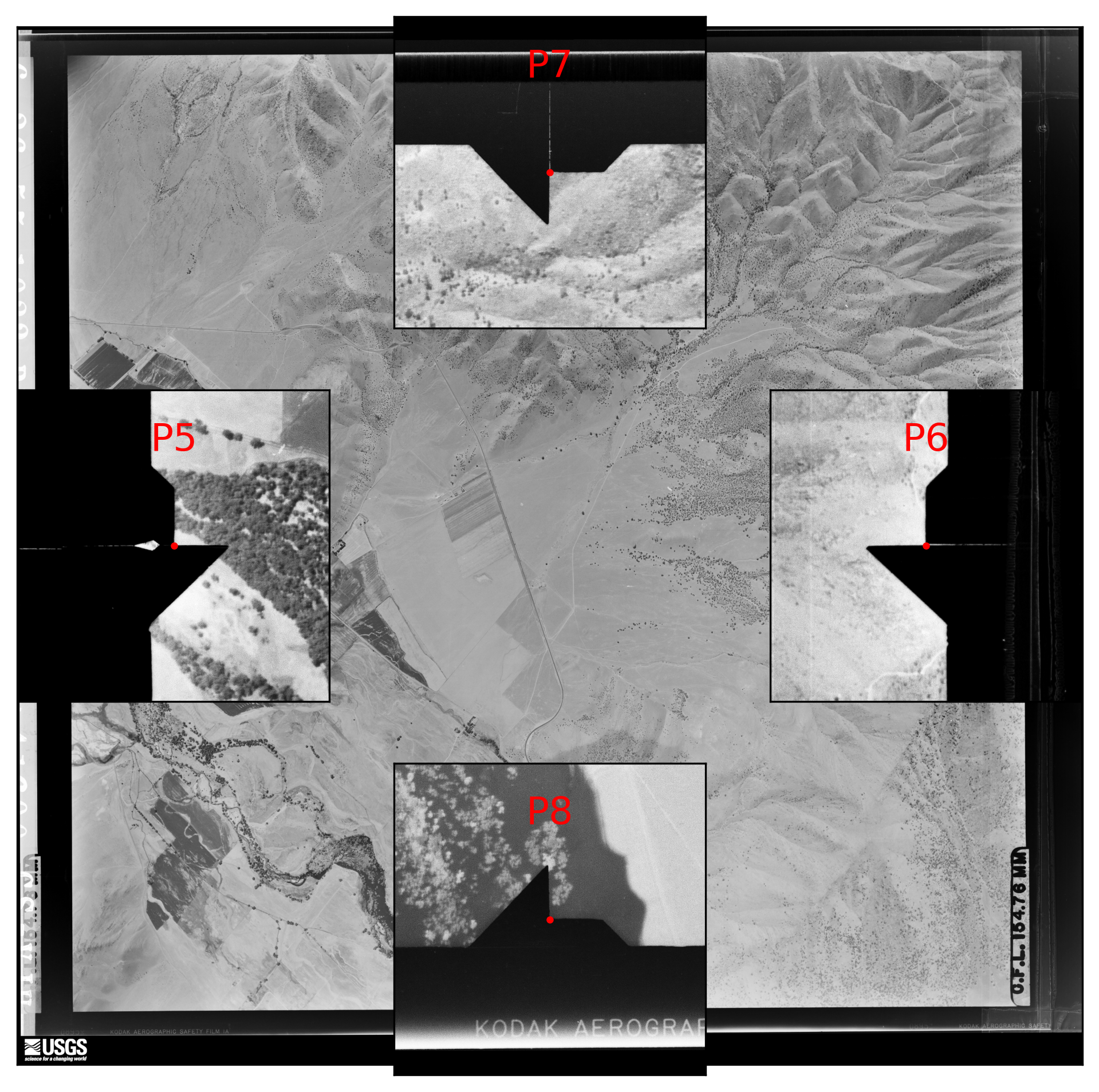
Marker Separation (n = 3 reports)
markers |
mean |
median |
|---|---|---|
P5 - P6 |
226.160 ± 0.694 |
225.88 |
P7 - P8 |
226.063 ± 0.808 |
225.87 |
Fairchild Cameras#
arrow-type fiducials#
Caution
I have been able to identify a single example of this type of fiducial marker connected to a calibration report, and a number of others to notes made on the edges of the frame of an image from a separate survey, or to the film identification information taken at the beginning of a roll.
The reported camera in all cases was a Fairchild K-17, but it is unclear whether the K-17 also used other fiducial
marker patterns (as appears to be the case based on calibration reports downloaded through Earth Explorer). As
with the wing-type examples shown above, therefore, I recommend using
estimate_measures_camera in the absence of any definitive
marker coordinates.
These cameras have four mid-side fiducial markers. Both P5 and P6 are “arrows” that (typically) point in the direction of flight. P5 is the tip of the arrow-shaped notch that is level with the frame, while P6 is the tip of the arrow-shaped notch that is cut into the frame.
Many prints (or scans) of images of this type will cut off the point of the notch on P7 and P8, so it is probably better to use the point where the vertical edge of the notch intersects the image frame, rather than the “point” of the notch.
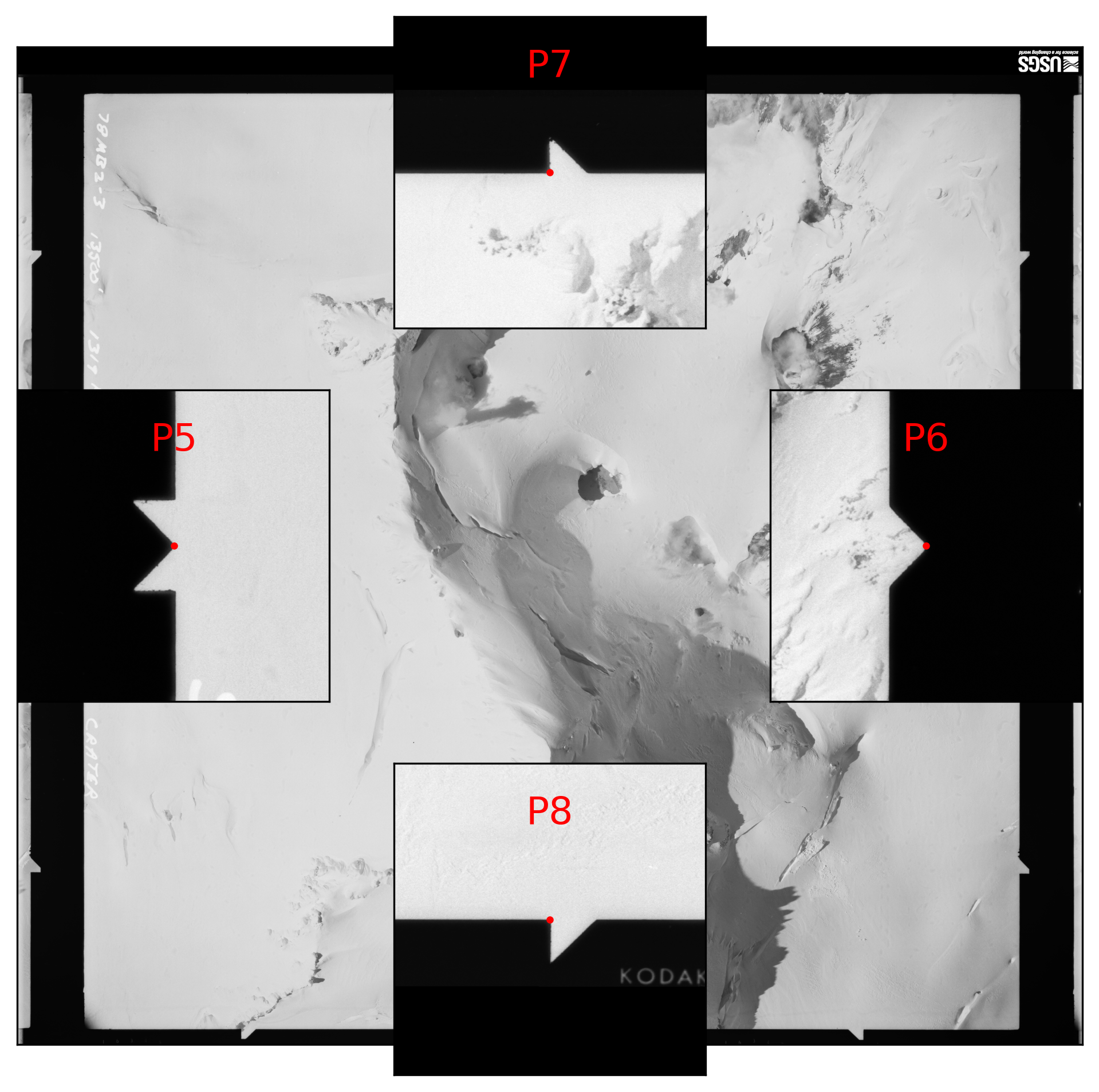
notch-type fiducials#
mid-side only#
This pattern was used in a number of different cameras, including T-11, T-12, KC-1, KC-1B, and CA-14. Note that the marker location is given by a small pinhole just inside the frame of the image, rather than the notch-shaped marks in the frame. Note also the distance between P5 and the principal point is longer than the distance between P6 and the principal point.
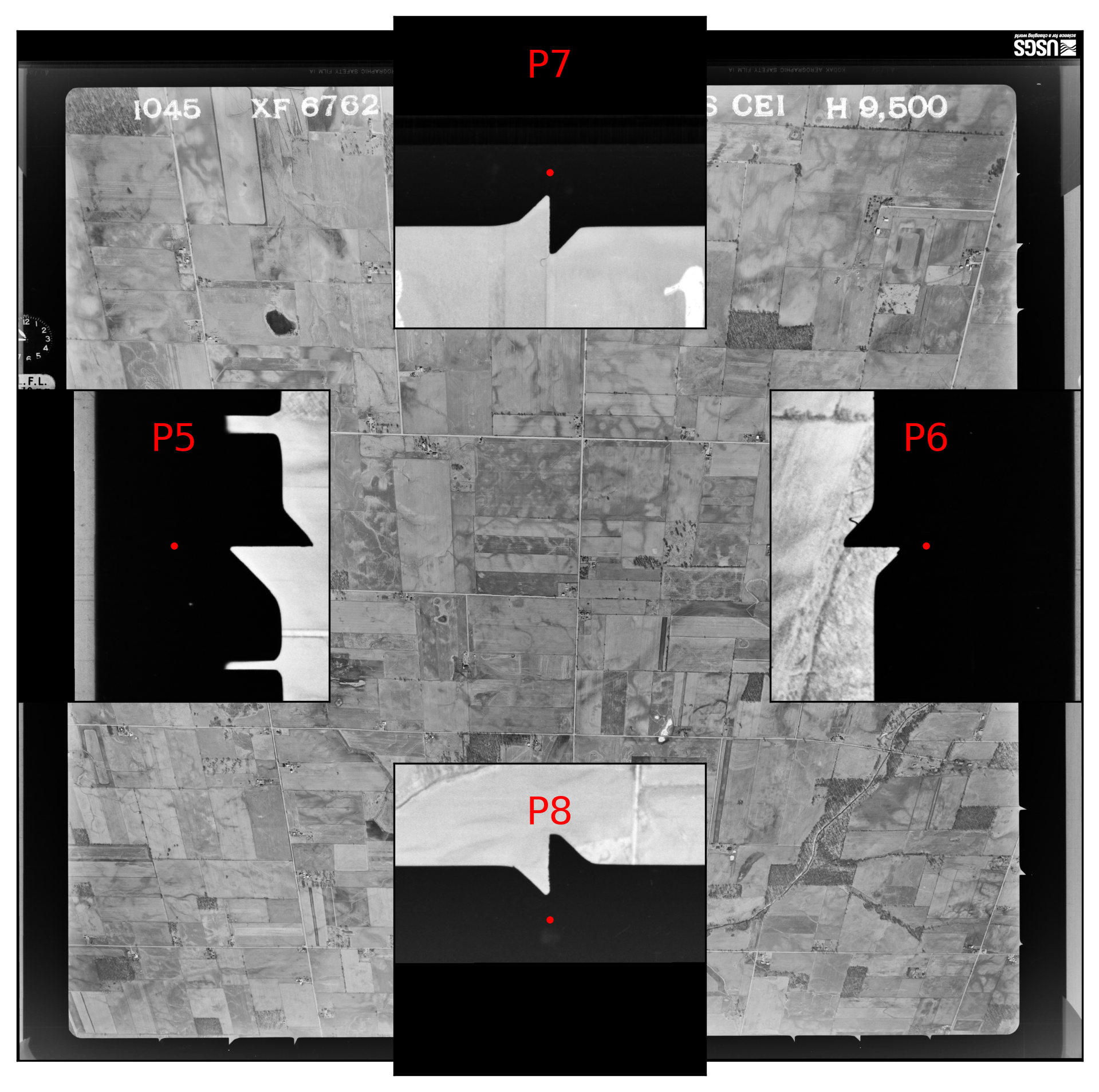
Marker Separation (n = 27 reports)
markers |
mean |
median |
|---|---|---|
P5 - P6 |
237.946 ± 0.223 |
237.94 |
P7 - P8 |
235.035 ± 0.206 |
235.016 |
Marker Location (n = 2 reports)
name |
x |
y |
angle |
|---|---|---|---|
P5 |
0.000 ± 0.063 |
117.521 ± 0.007 |
179.995 |
P6 |
237.846 ± 0.050 |
117.521 ± 0.007 |
0.005 |
P7 |
120.428 ± 0.001 |
0.000 ± 0.038 |
89.995 |
P8 |
120.421 ± 0.007 |
235.000 ± 0.053 |
270.001 |
T-12#
Similar to the pattern shown above, some versions of the T-12 also used corner fiducial markers. Note that the fiducial marker for each of these is a small pinhole just inside the frame, rather than the notch-shaped marks in the frame.
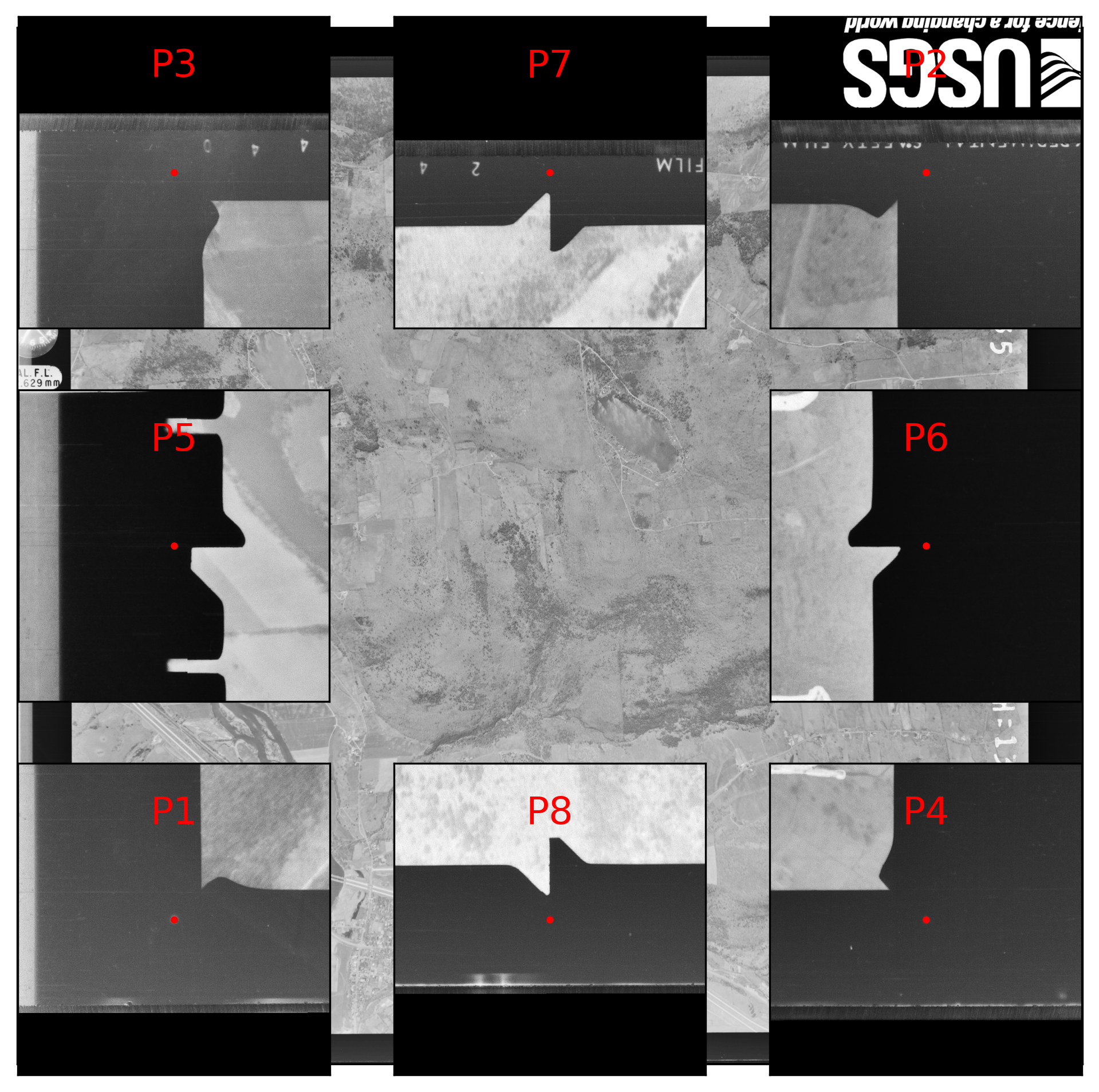
Note
In some of these models, P5 is further inside of the left-hand side of the frame, which is why the variability of the P5-P6 separation, and the x location of P5, is much higher than for the other markers.
Marker Separation (n = 5 reports)
markers |
mean |
median |
|---|---|---|
P5 - P6 |
236.403 ± 1.657 |
235.201 |
P7 - P8 |
235.236 ± 0.137 |
235.205 |
P1 - P2 |
328.163 ± 0.850 |
328.256 |
P3 - P4 |
328.156 ± 0.838 |
328.24 |
Marker Location (n = 3 reports)
name |
x |
y |
angle |
|---|---|---|---|
P1 |
3.601 ± 0.335 |
233.519 ± 0.296 |
224.999 |
P2 |
235.453 ± 0.321 |
1.622 ± 0.303 |
45.012 |
P3 |
3.619 ± 0.302 |
1.664 ± 0.372 |
135.004 |
P4 |
235.517 ± 0.274 |
233.519 ± 0.296 |
315.007 |
P5 |
0.000 ± 1.694 |
117.645 ± 0.083 |
180.033 |
P6 |
237.211 ± 0.118 |
117.481 ± 0.079 |
0.046 |
P7 |
119.465 ± 0.072 |
0.000 ± 0.112 |
90.039 |
P8 |
119.613 ± 0.059 |
235.248 ± 0.113 |
270.033 |
The T-12 camera also used cross-type fiducial markers instead of dots, with the same approximate measurements:
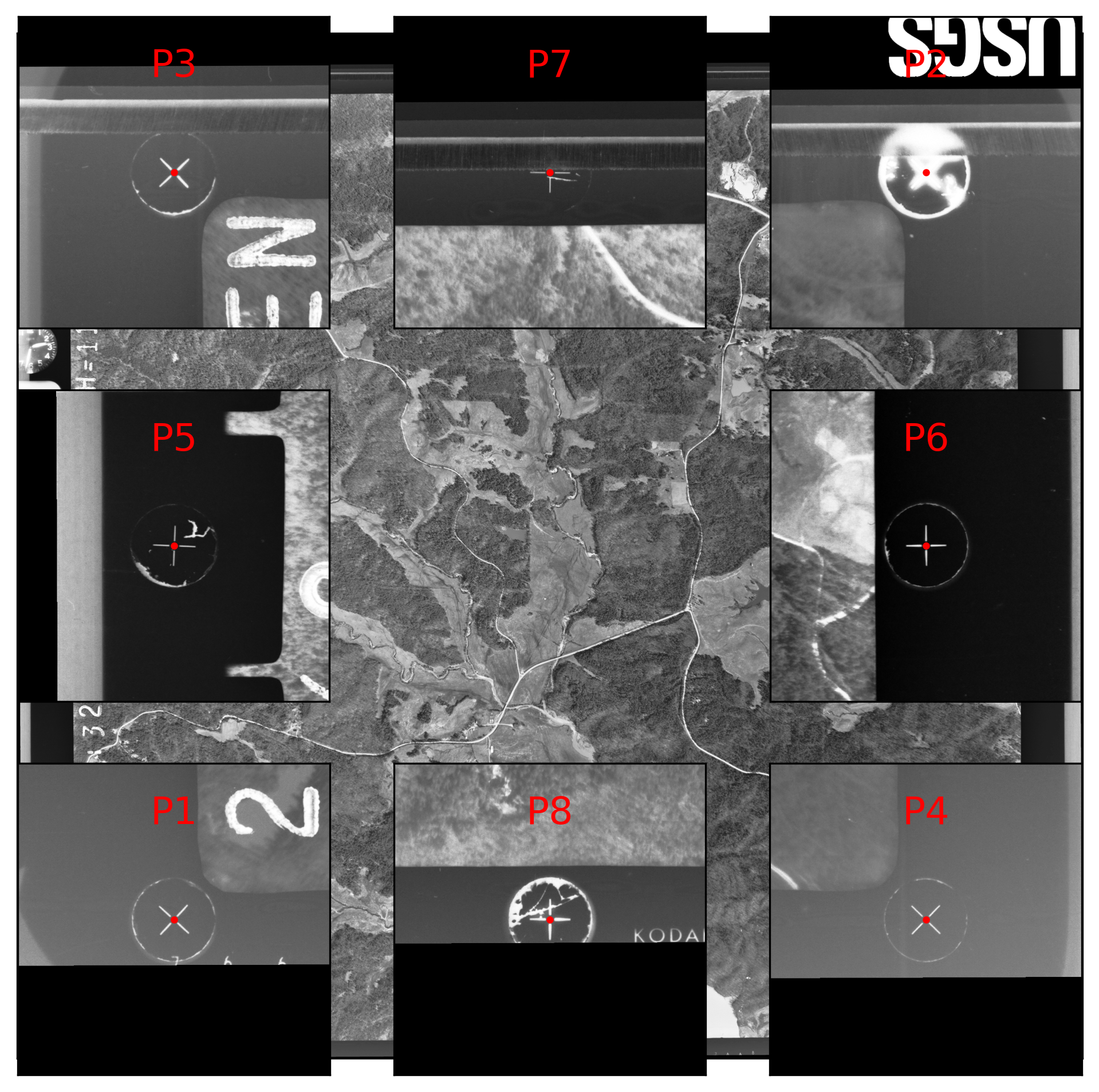
T-5#
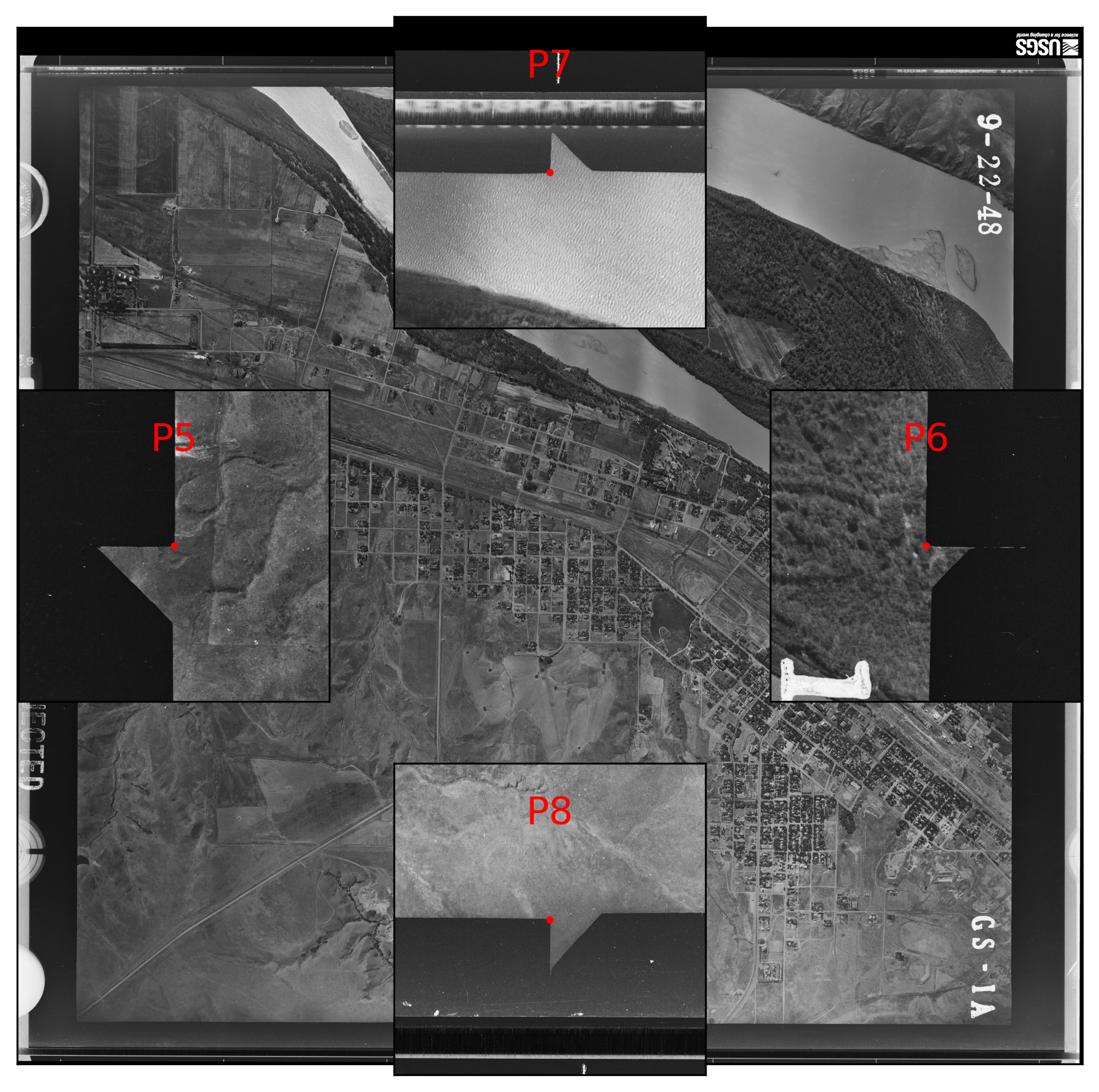
Based on diagrams like this one, which are included in some calibration reports, I am taking the location of each fiducial marker to be the corner formed by the horizontal/vertical edge of the notch, and the image frame:
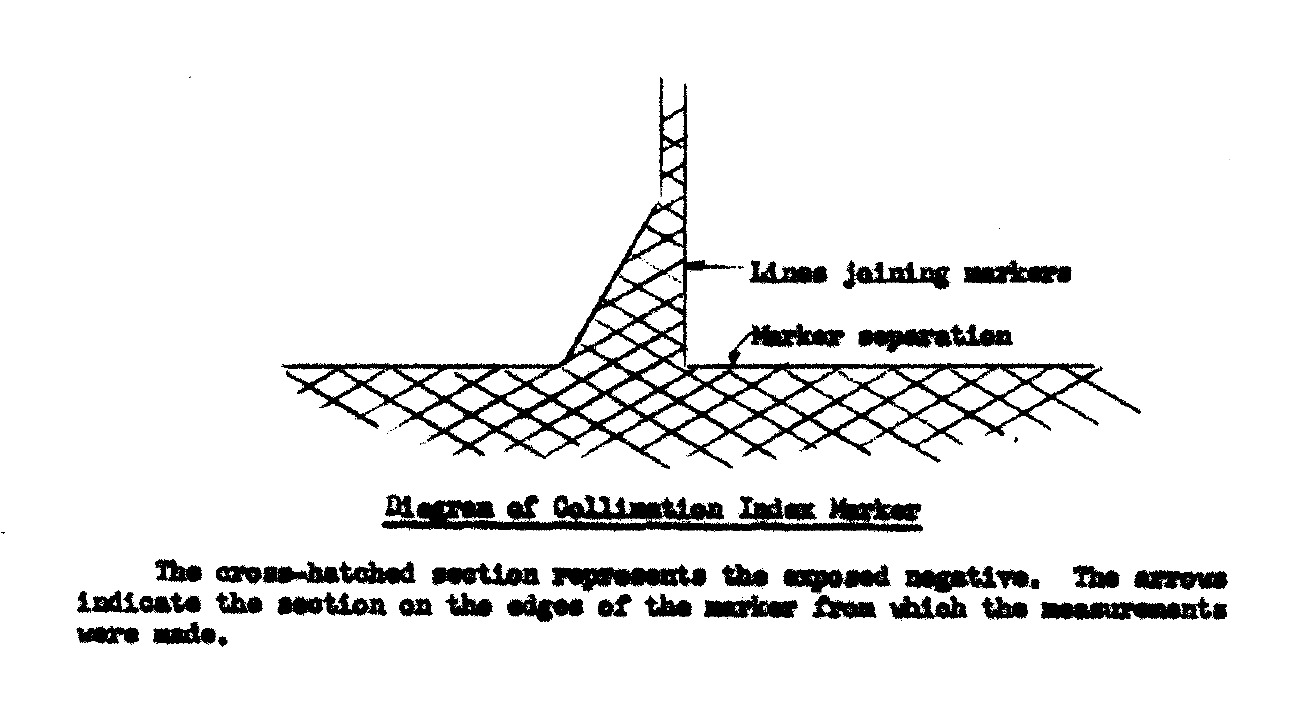
If the data strip is not visible on the image, you should be able to identify P5 as being a slightly larger than
the other three notches.
Marker Separation (n = 4 reports)
markers |
mean |
median |
|---|---|---|
P5 - P6 |
229.688 ± 0.219 |
229.645 |
P7 - P8 |
229.950 ± 0.014 |
229.955 |
KC-6A#
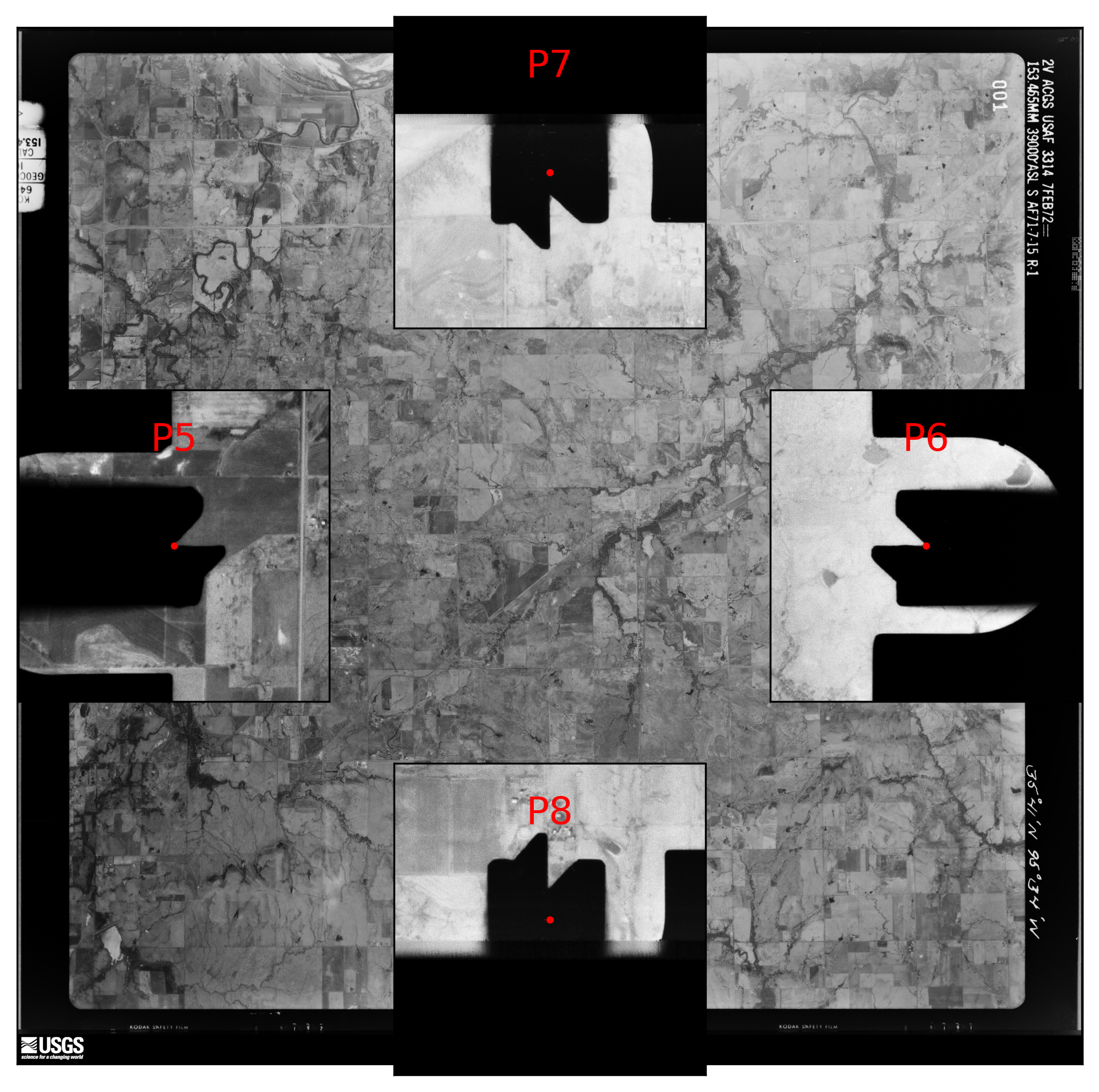
The Fairchild KC-6A used four mid-side wing/notch-shaped fiducial markers. In addition to P7 and P8, there are two markers that are not included in the calibration report; these are off-center, and closer to P5 than to P6.
On most examples of the KC-6A that I have seen, there is a direction of flight arrow at the bottom of the area where the serial number and other ancillary information is shown (in the upper left of the example below).
It is not completely clear whether the marker is meant to be a small dot just inside the frame, as on the T-11 and T-12 examples above, or the tip of the notch cut into the frame. Based on the longer separation distance for P7-P8 compared to P5-P6 in the example calibration report, and the fact that in the example below, dots are visible on P7 and P8 but not on P5 and P6, I have used the dots for P7 and P8 but not for P5 and P6.
In other images, no dots are visible, though this may be due to issues with exposure/development of the film. Because
of this, and the lack of scanned calibration reports for this type of camera, it might be better to use the tip of the
notch, as is done for P5 and P6, and use estimate_measures_camera.
Note
There is a single calibration report for a Fairchild KC-6A in the USGS calibration report database, but it is mislabeled as a KC-8A.
Based on information taken from a film identification image (EarthExplorer ID: ARHHORNT110X172), the Fairchild F-489 “Terrain Objective Camera” (TROC) used a similar pattern, but did not have an identification strip with the camera make/model and serial number exposed. There are also no F-489 cameras available from the USGS database.
Marker Separation (n = 1 reports)
markers |
mean |
median |
|---|---|---|
P5 - P6 |
234.893 ± nan |
234.893 |
P7 - P8 |
236.089 ± nan |
236.089 |
Marker Location (n = 1 reports)
name |
x |
y |
angle |
|---|---|---|---|
P5 |
0.000 ± nan |
117.939 ± nan |
180.018 |
P6 |
234.893 ± nan |
117.939 ± nan |
359.982 |
P7 |
117.147 ± nan |
0.000 ± nan |
90.014 |
P8 |
117.231 ± nan |
236.089 ± nan |
270.027 |
checker-type fiducials#
T-11#
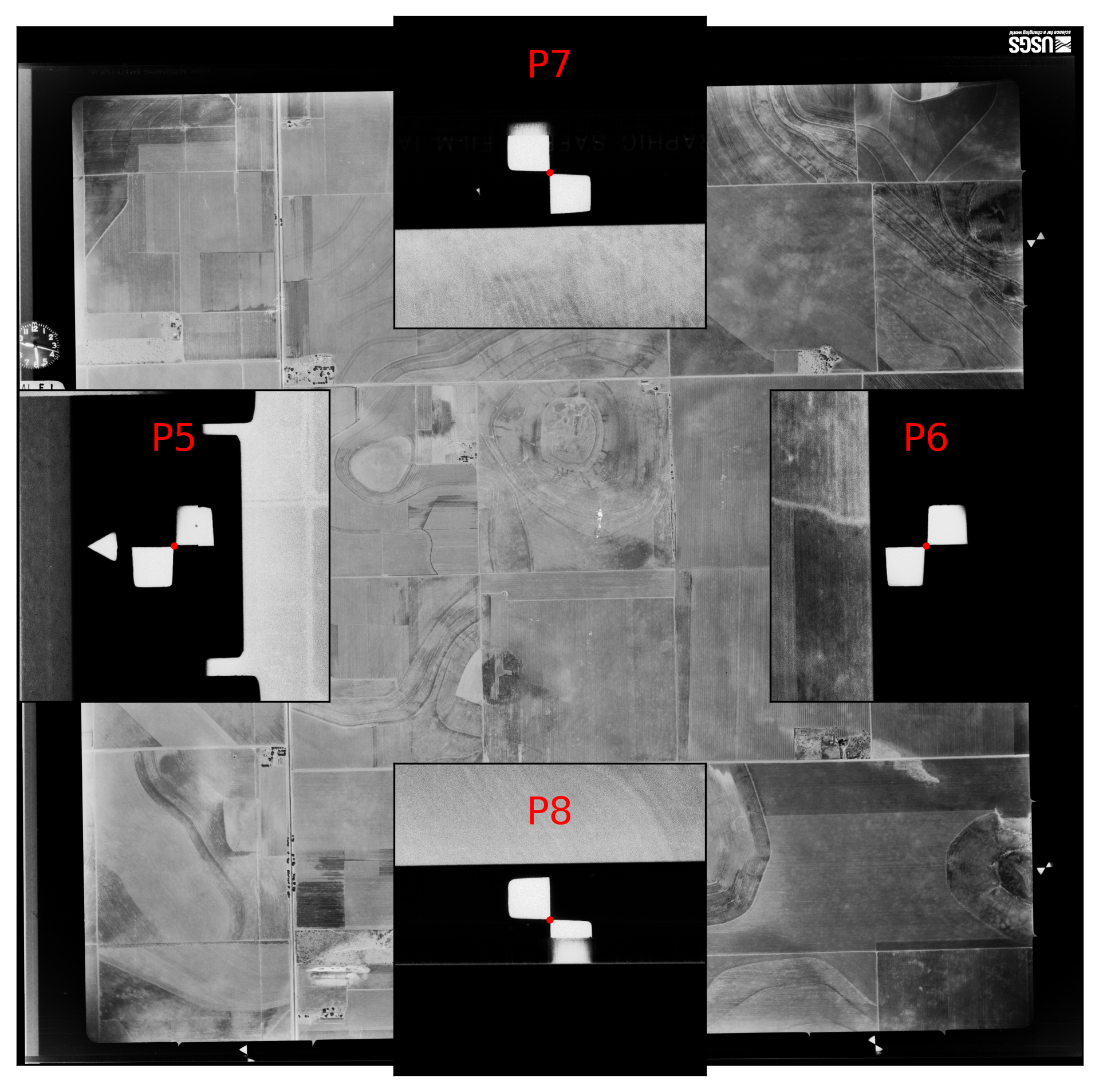
Some versions of the T-11 used checker-type fiducials like the one shown below. Note the direction of flight indicator next to the P5 marker:
Park Cameras#
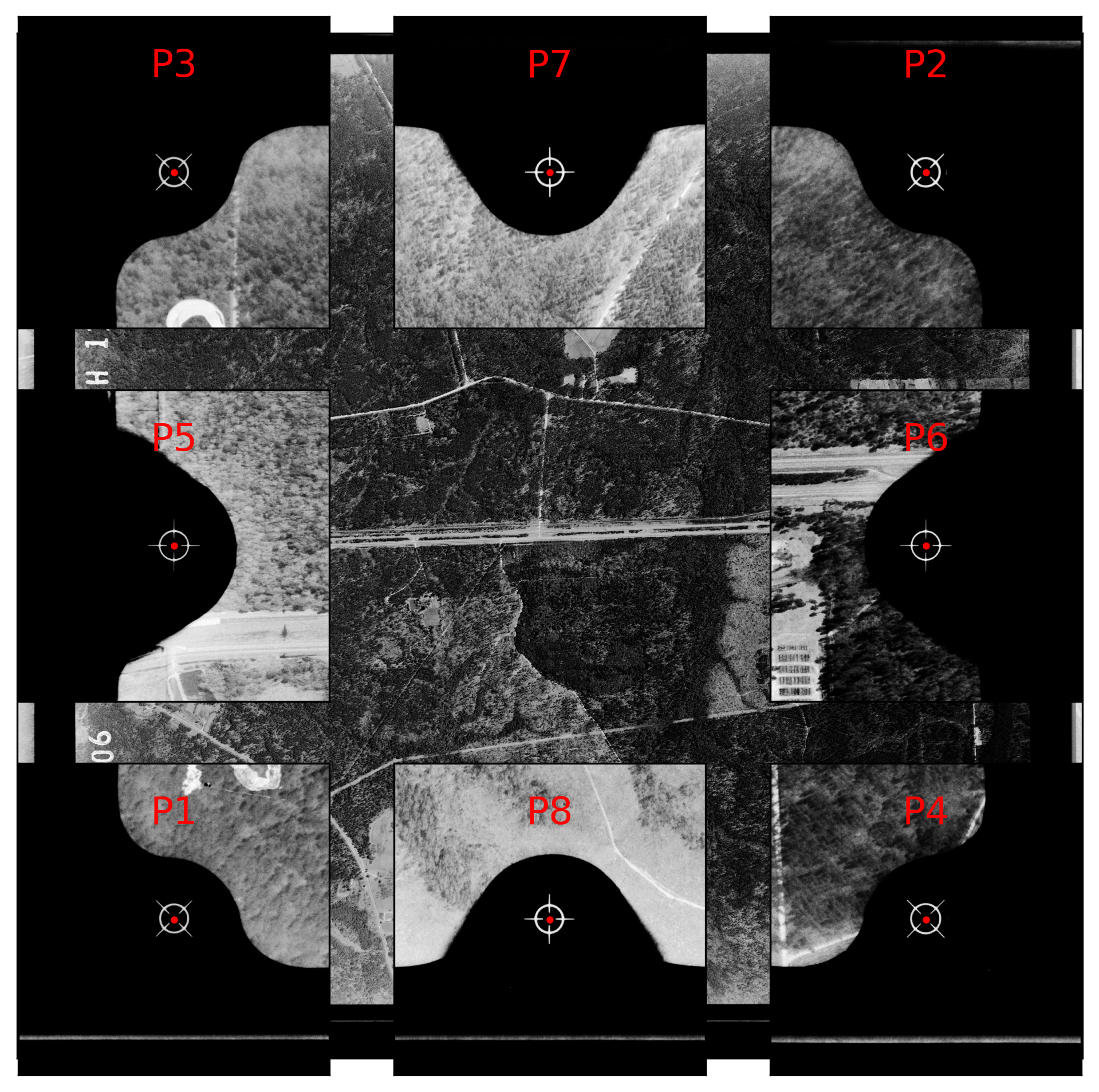
In addition to the wing-style fiducial marker pattern, Park Aerial Surveys, Inc. manufactured and used cameras with eight crosshair-style fiducial markers (four corner, four mid-side).
These look very similar to the Wild Heerbrugg RC8 and RC10 crosshair-style cameras shown below, but are distinguished by the corner fiducial markers being closer to the frame (further from the principal point) and set inside of a smaller rounded frame:
Some, but not all, of these cameras also displayed either the camera serial number and focal length, or just the
focal length, on the side of the frame near one of the fiducial markers.
Marker Separation (n = 12 reports)
markers |
mean |
median |
|---|---|---|
P5 - P6 |
223.781 ± 0.039 |
223.786 |
P7 - P8 |
223.793 ± 0.032 |
223.802 |
P1 - P2 |
316.532 ± 0.033 |
316.537 |
P3 - P4 |
316.524 ± 0.028 |
316.52 |
Marker Location (n = 6 reports)
name |
x |
y |
angle |
|---|---|---|---|
P1 |
0.000 ± 0.021 |
223.825 ± 0.015 |
224.995 |
P2 |
223.808 ± 0.022 |
0.000 ± 0.016 |
45.009 |
P3 |
0.005 ± 0.009 |
0.028 ± 0.017 |
135.001 |
P4 |
223.821 ± 0.017 |
223.825 ± 0.015 |
315.004 |
P5 |
0.033 ± 0.018 |
111.922 ± 0.016 |
179.996 |
P6 |
223.804 ± 0.035 |
111.909 ± 0.014 |
0.011 |
P7 |
111.900 ± 0.019 |
0.037 ± 0.019 |
90.006 |
P8 |
111.932 ± 0.012 |
223.821 ± 0.020 |
270.01 |
Wild Heerbrugg Cameras#
corner-only fiducials#
Earlier Wild RC cameras, such as the RC5 or RC5A, or earlier versions of the RC8 or RC9, have four cross-shaped fiducial marks in the corners, set inside of a rounded frame:
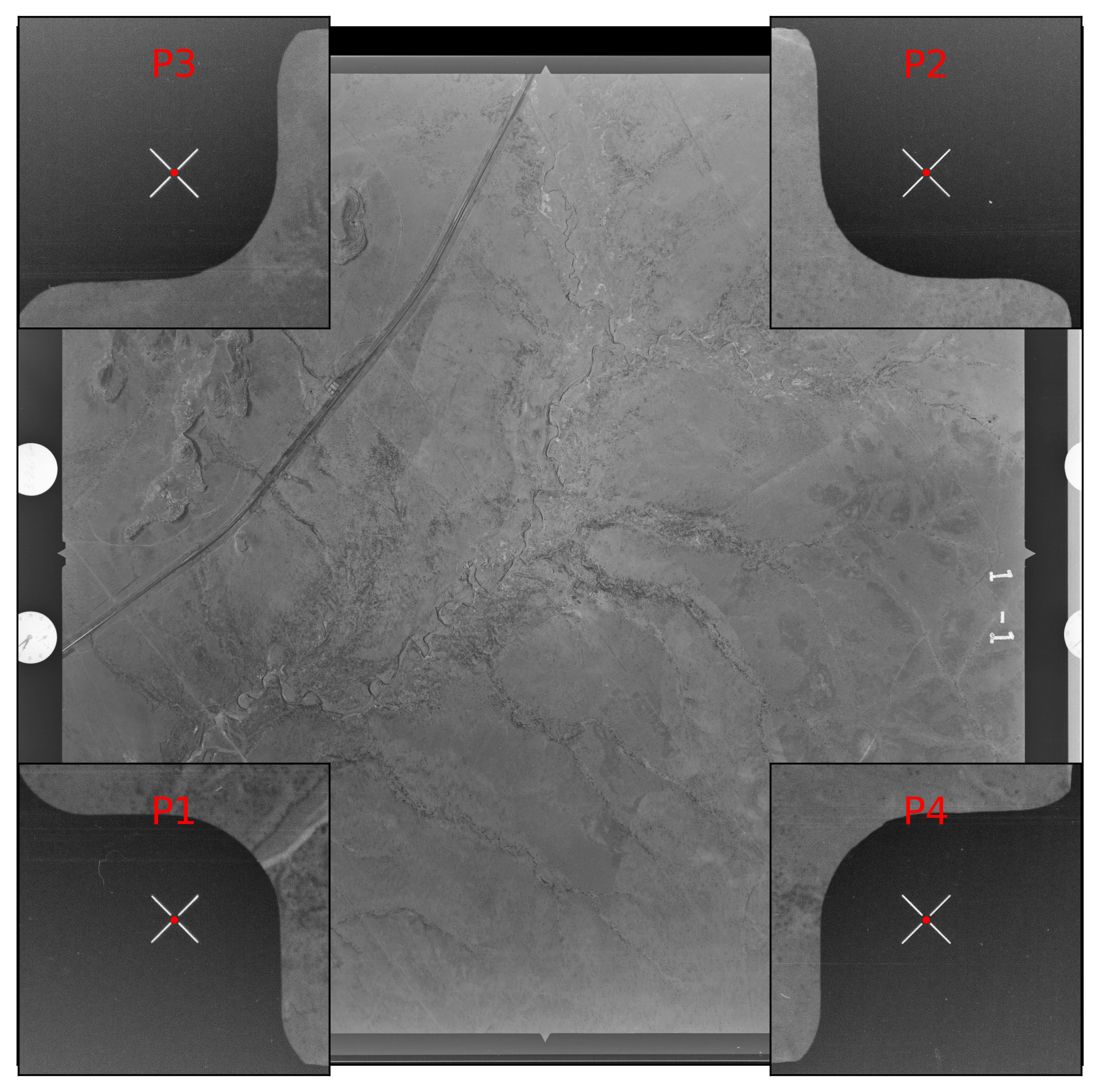
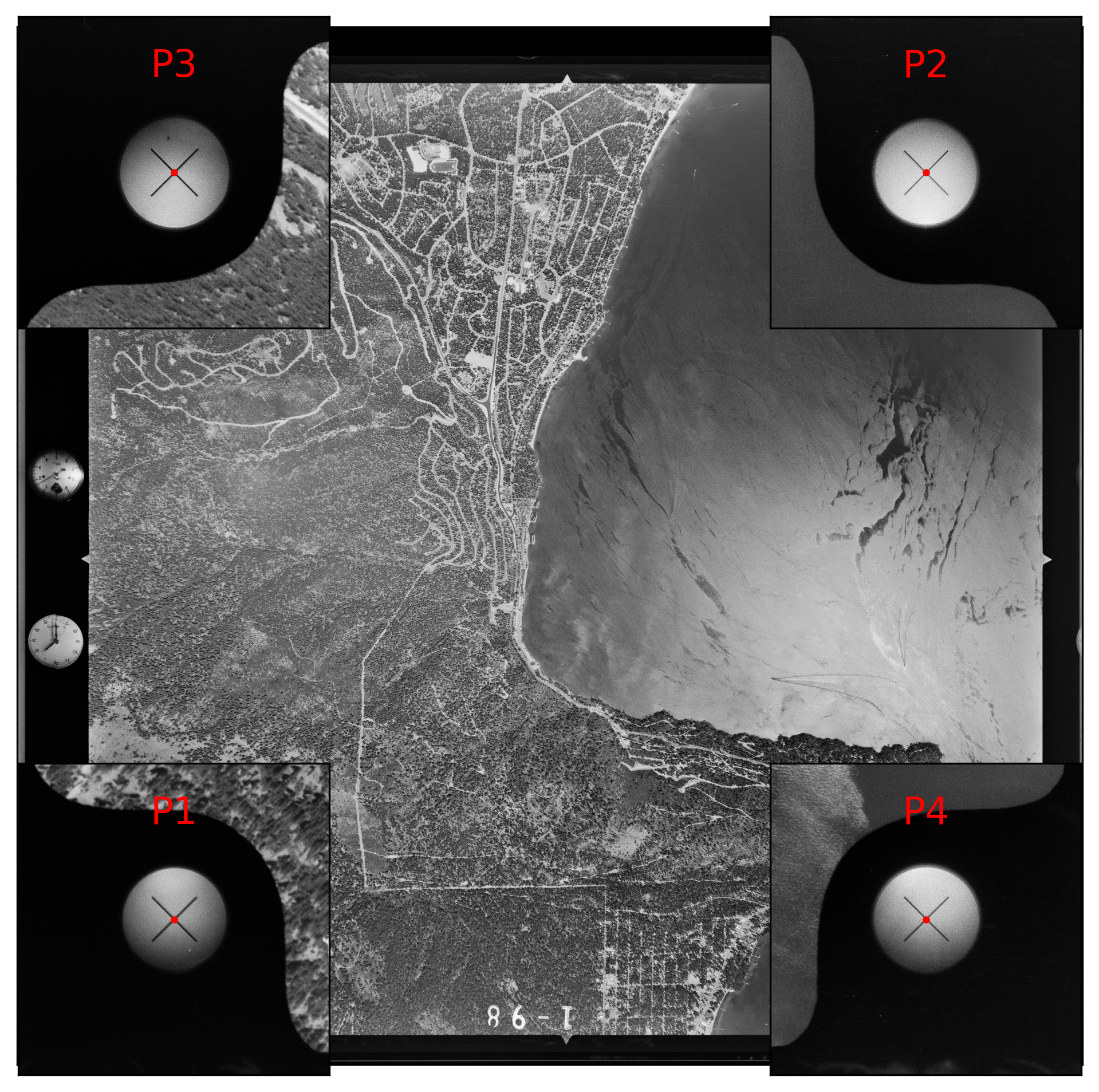
Some versions also used an alternate corner marker:
Marker Separation (n = 48 reports)
markers |
mean |
median |
|---|---|---|
P1 - P2 |
299.815 ± 0.011 |
299.813 |
P3 - P4 |
299.818 ± 0.013 |
299.818 |
Marker Location (n = 15 reports)
name |
x |
y |
angle |
|---|---|---|---|
P1 |
0.000 ± 0.010 |
212.002 ± 0.008 |
225.001 |
P2 |
211.999 ± 0.014 |
0.000 ± 0.015 |
45.000 |
P3 |
0.000 ± 0.012 |
0.001 ± 0.010 |
135.001 |
P4 |
212.006 ± 0.007 |
212.002 ± 0.008 |
315.000 |
Marker Separation (alternate corner, n = 2)
markers |
mean |
median |
|---|---|---|
P1 - P2 |
299.842 ± 0.003 |
299.842 |
P3 - P4 |
299.798 ± 0.017 |
299.798 |
corner + mid-side fiducials#
Later versions of the RC8 camera, as well as the RC10 camera, used a pattern with eight fiducial markers: four corner markers as on the corner type, and four mid-side markers.
These markers may be all larger crosses, as in the corner marker types (these were typically RC8 cameras):
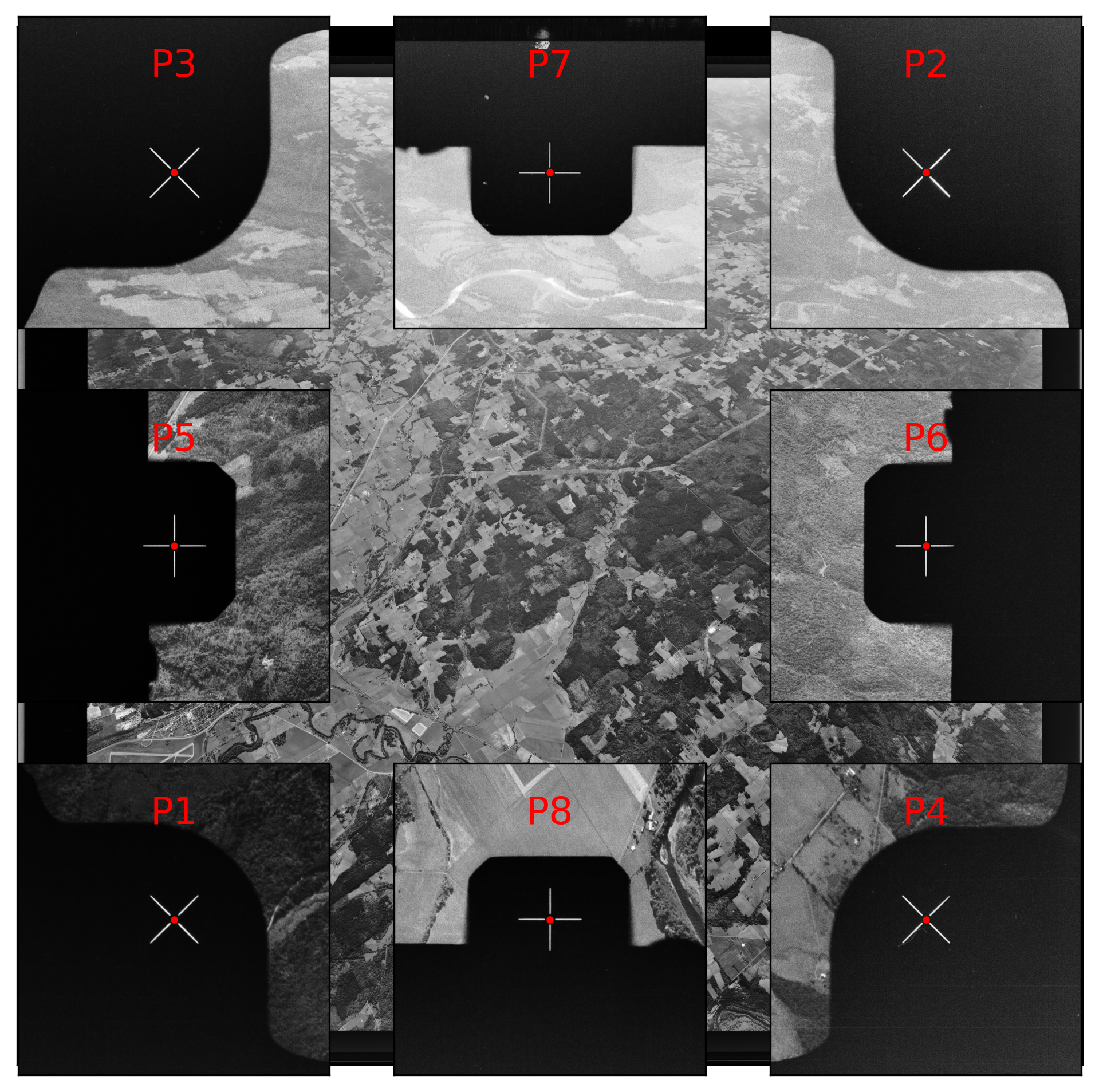
Marker Separation (n = 32 reports)
markers |
mean |
median |
|---|---|---|
P5 - P6 |
219.995 ± 0.008 |
219.996 |
P7 - P8 |
219.998 ± 0.009 |
220 |
P1 - P2 |
299.815 ± 0.009 |
299.813 |
P3 - P4 |
299.805 ± 0.008 |
299.803 |
Marker Location (n = 15 reports)
name |
x |
y |
angle |
|---|---|---|---|
P1 |
3.998 ± 0.010 |
215.993 ± 0.010 |
224.998 |
P2 |
216.004 ± 0.006 |
4.000 ± 0.009 |
44.999 |
P3 |
3.998 ± 0.006 |
3.997 ± 0.011 |
135 |
P4 |
215.989 ± 0.010 |
215.993 ± 0.010 |
314.999 |
P5 |
0.000 ± 0.006 |
109.996 ± 0.012 |
179.998 |
P6 |
219.996 ± 0.010 |
110.000 ± 0.009 |
359.999 |
P7 |
110.004 ± 0.006 |
0.000 ± 0.010 |
89.998 |
P8 |
109.994 ± 0.013 |
220.001 ± 0.012 |
269.997 |
Or, the markers might be a mix of cross-style markers in the corner, and crosshair style on the mid-side markers (again, these are typically RC8 cameras):
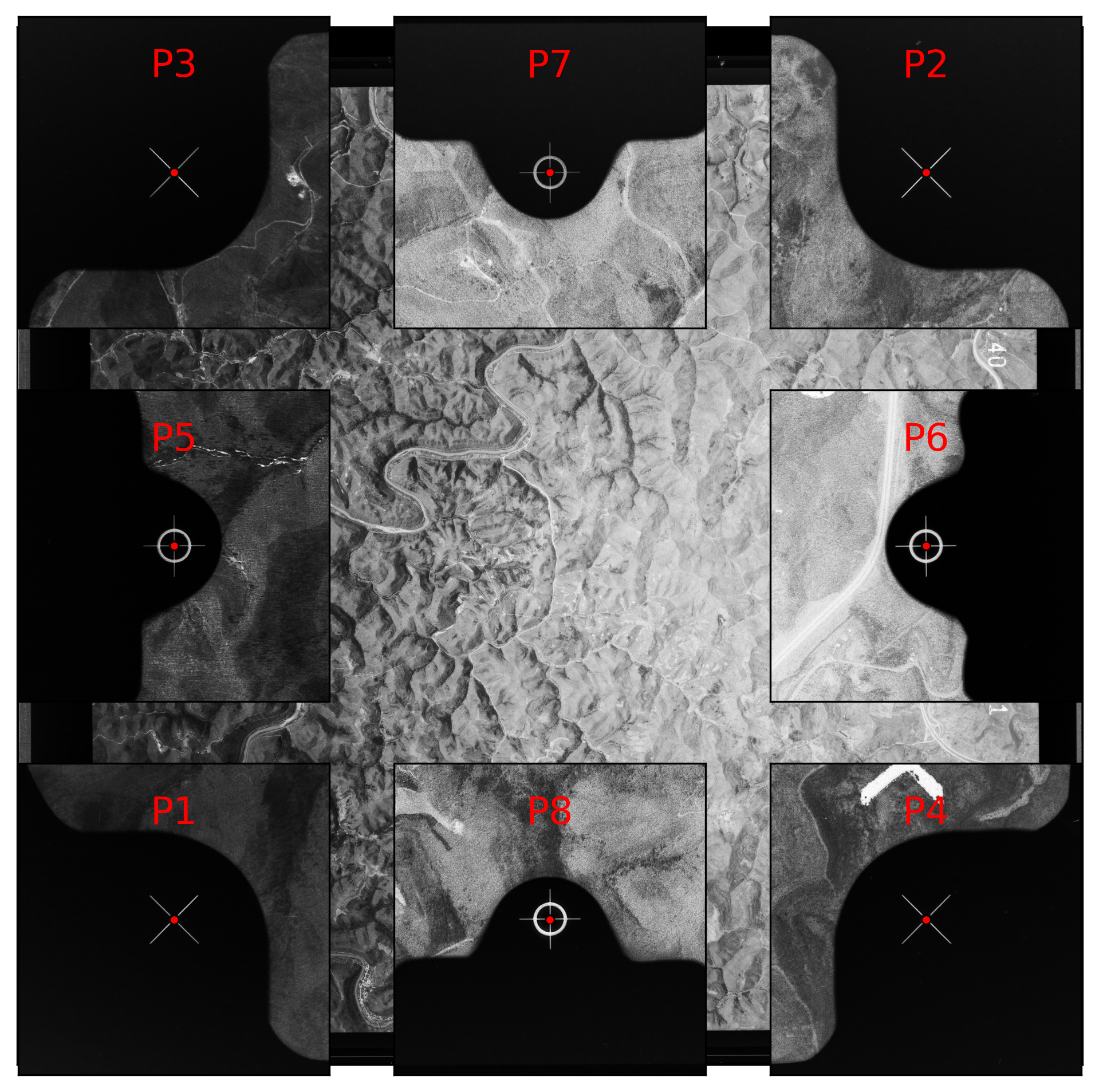
Marker Separation (n = 10 reports)
markers |
mean |
median |
|---|---|---|
P5 - P6 |
220.000 ± 0.011 |
219.999 |
P7 - P8 |
220.005 ± 0.008 |
220.004 |
P1 - P2 |
299.815 ± 0.009 |
299.814 |
P3 - P4 |
299.810 ± 0.009 |
299.812 |
Marker Location (n = 9 reports)
name |
x |
y |
angle |
|---|---|---|---|
P1 |
4.002 ± 0.012 |
216.000 ± 0.009 |
224.999 |
P2 |
216.006 ± 0.013 |
4.000 ± 0.012 |
45 |
P3 |
4.002 ± 0.007 |
3.999 ± 0.009 |
134.999 |
P4 |
215.997 ± 0.009 |
216.000 ± 0.009 |
314.999 |
P5 |
0.000 ± 0.009 |
110.005 ± 0.015 |
180.002 |
P6 |
220.000 ± 0.012 |
109.999 ± 0.011 |
0.001 |
P7 |
110.006 ± 0.012 |
0.000 ± 0.012 |
89.998 |
P8 |
109.996 ± 0.009 |
220.004 ± 0.010 |
269.997 |
Or, they might be all crosshair style markers (typically RC10 cameras):
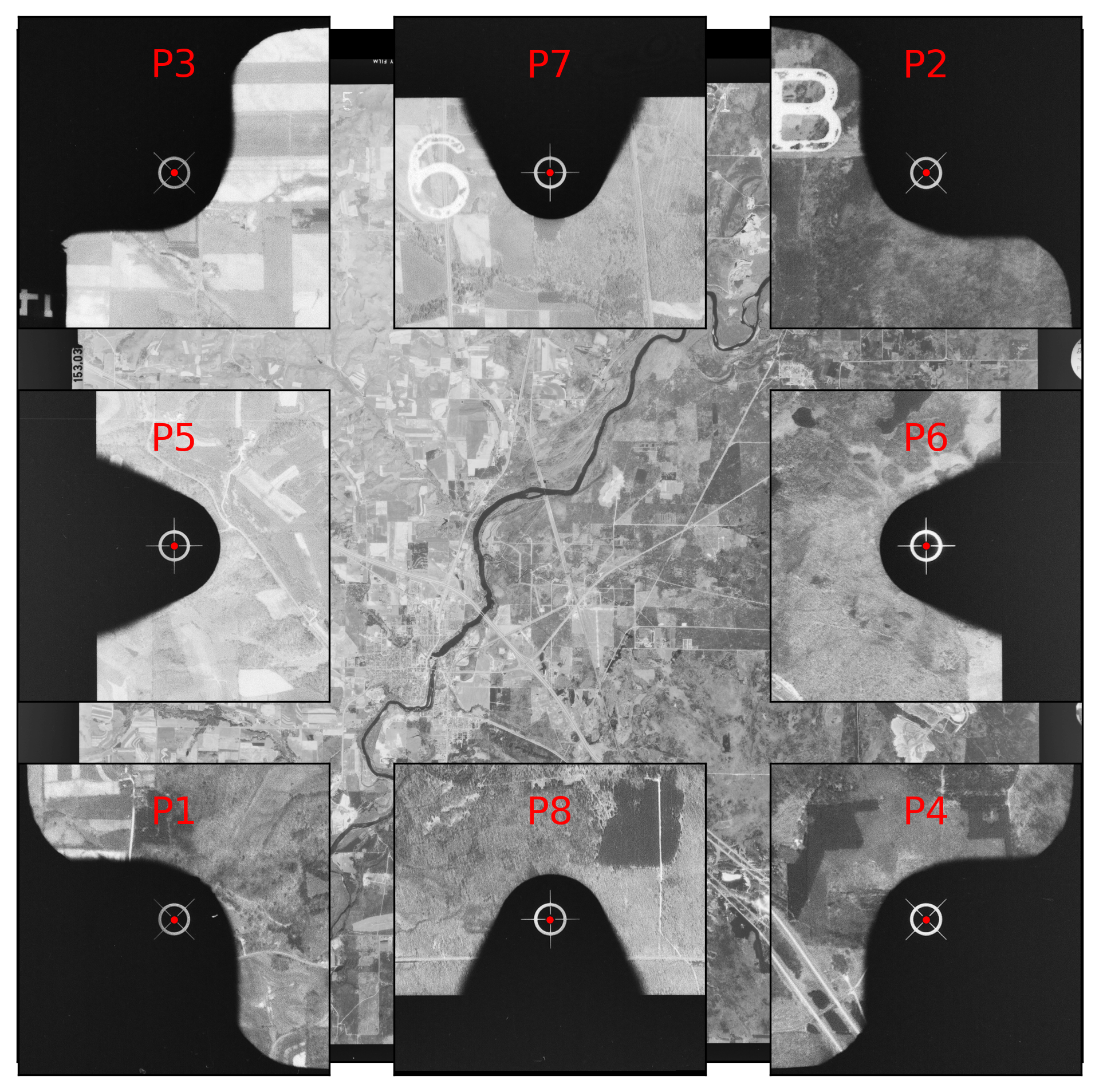
Marker Separation (n = 23 reports)
markers |
mean |
median |
|---|---|---|
P5 - P6 |
220.008 ± 0.048 |
219.999 |
P7 - P8 |
219.998 ± 0.009 |
220 |
P1 - P2 |
299.814 ± 0.008 |
299.814 |
P3 - P4 |
299.807 ± 0.012 |
299.806 |
Marker Location (n = 16 reports)
name |
x |
y |
angle |
|---|---|---|---|
P1 |
3.999 ± 0.013 |
215.998 ± 0.006 |
225 |
P2 |
216.003 ± 0.014 |
4.002 ± 0.007 |
44.998 |
P3 |
4.005 ± 0.012 |
4.002 ± 0.006 |
134.997 |
P4 |
215.992 ± 0.013 |
215.998 ± 0.006 |
315 |
P5 |
0.000 ± 0.012 |
109.999 ± 0.011 |
179.999 |
P6 |
220.012 ± 0.060 |
109.998 ± 0.009 |
0.002 |
P7 |
110.002 ± 0.012 |
0.000 ± 0.007 |
89.996 |
P8 |
109.997 ± 0.013 |
219.996 ± 0.007 |
270.001 |
Zeiss RMK Cameras#
Note
The model name for the Zeiss RMK includes information about the lens and film type. For example:
Zeiss RMK 15/23 means that the camera uses a Pleogon lens with a ~15 cm (~150 mm) focal length and 23 cm film.
Zeiss RMK A 15/23 means that the camera uses a Pleogon A lens with a ~15 cm focal length and 23 cm film.
Zeiss RMK A 21/23 means that the camera uses a Pleogon A lens with a ~21 cm focal length and 23 cm film.
Zeiss RMK A 30/23 means that the camera uses a Pleogon A lens with a ~30 cm focal length and 23 cm film
… and so on. This pattern doesn’t necessarily tell you the pattern of the fiducial markers, but it should at least give you a rough idea of the focal length and film size of the camera.
mid-side only#
Earlier models tended to use only mid-side fiducial markers:
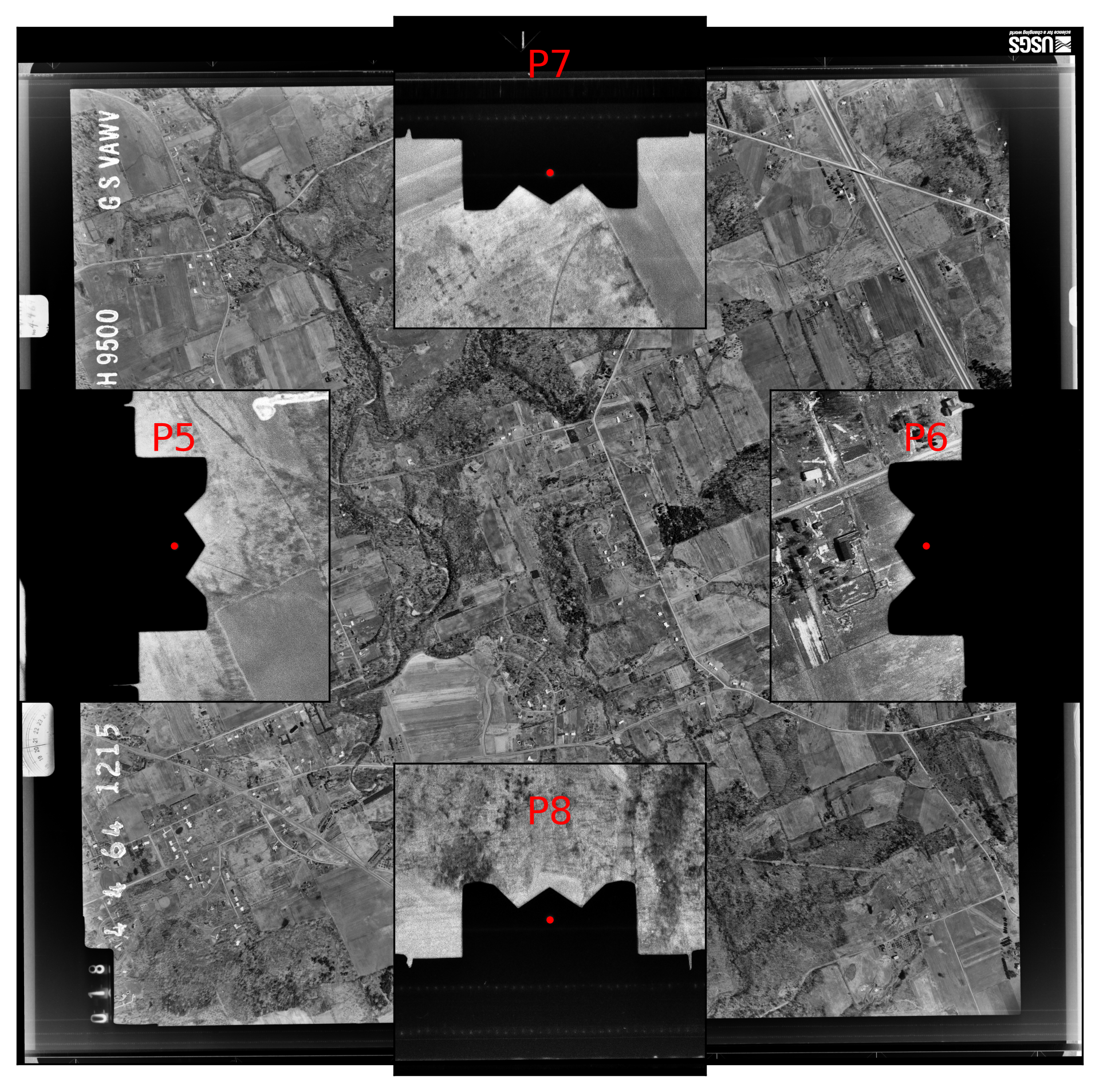
Marker Separation (n = 41 reports)
markers |
mean |
median |
|---|---|---|
P5 - P6 |
225.995 ± 0.062 |
226.001 |
P7 - P8 |
226.008 ± 0.038 |
226.01 |
Marker Location (n = 5 reports)
name |
x |
y |
angle |
|---|---|---|---|
P5 |
0.000 ± 0.008 |
112.978 ± 0.009 |
180.002 |
P6 |
225.983 ± 0.016 |
112.978 ± 0.009 |
359.998 |
P7 |
112.990 ± 0.012 |
0.000 ± 0.021 |
90.004 |
P8 |
112.995 ± 0.009 |
225.973 ± 0.007 |
269.999 |
corner fiducial markers#
Note
The separation distance and location for the corner fiducial markers (P1, P2, P3, and P4) for these cameras tends to be much more variable than the mid-side fiducial marker location (cf. \(\sigma > 0.3\) vs. \(\sigma < 0.05\)).
As with previous examples, it is likely a “safer” option to use
estimate_measures_camera rather than the average measures
below, at least for the corner fiducial markers.
Later(?) versions of the Zeiss RMK camera used eight fiducial markers: four mid-side markers, and four corner markers. These came in (at least) two main styles: a “floating style”:
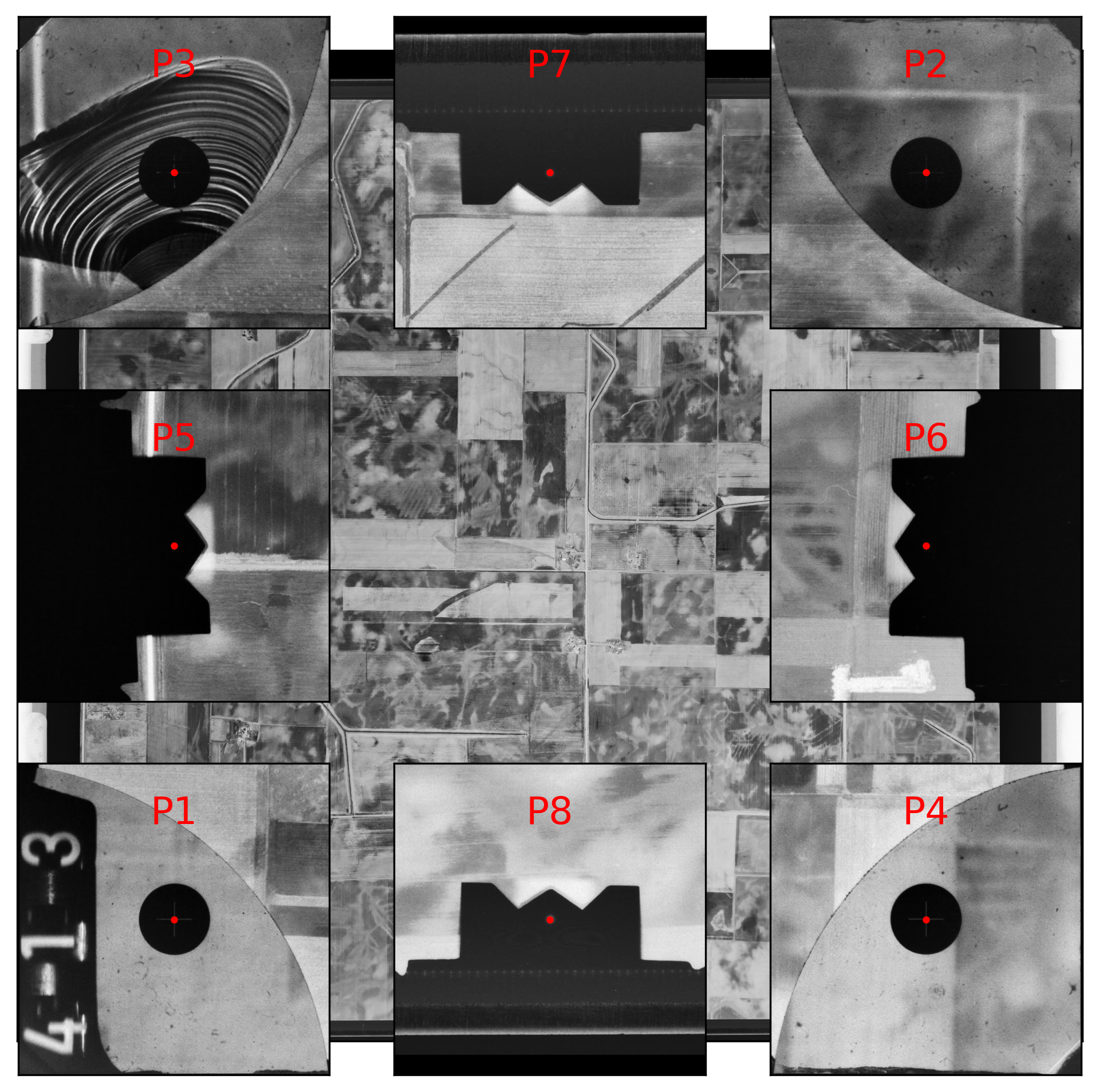
Marker Separation (n = 60 reports)
markers |
mean |
median |
|---|---|---|
P5 - P6 |
225.991 ± 0.024 |
225.992 |
P7 - P8 |
225.993 ± 0.028 |
225.995 |
P1 - P2 |
294.470 ± 0.735 |
294.101 |
P3 - P4 |
294.461 ± 0.713 |
294.112 |
Marker Location (n = 20 reports)
name |
x |
y |
angle |
|---|---|---|---|
P1 |
8.800 ± 0.368 |
217.162 ± 0.326 |
224.99 |
P2 |
217.161 ± 0.362 |
8.837 ± 0.332 |
45 |
P3 |
8.815 ± 0.343 |
8.797 ± 0.365 |
134.996 |
P4 |
217.136 ± 0.324 |
217.162 ± 0.326 |
314.992 |
P5 |
0.000 ± 0.015 |
112.993 ± 0.037 |
179.998 |
P6 |
225.981 ± 0.018 |
112.996 ± 0.029 |
0 |
P7 |
112.999 ± 0.033 |
0.000 ± 0.014 |
90.001 |
P8 |
112.998 ± 0.038 |
225.983 ± 0.023 |
269.998 |
and a “fixed” style:
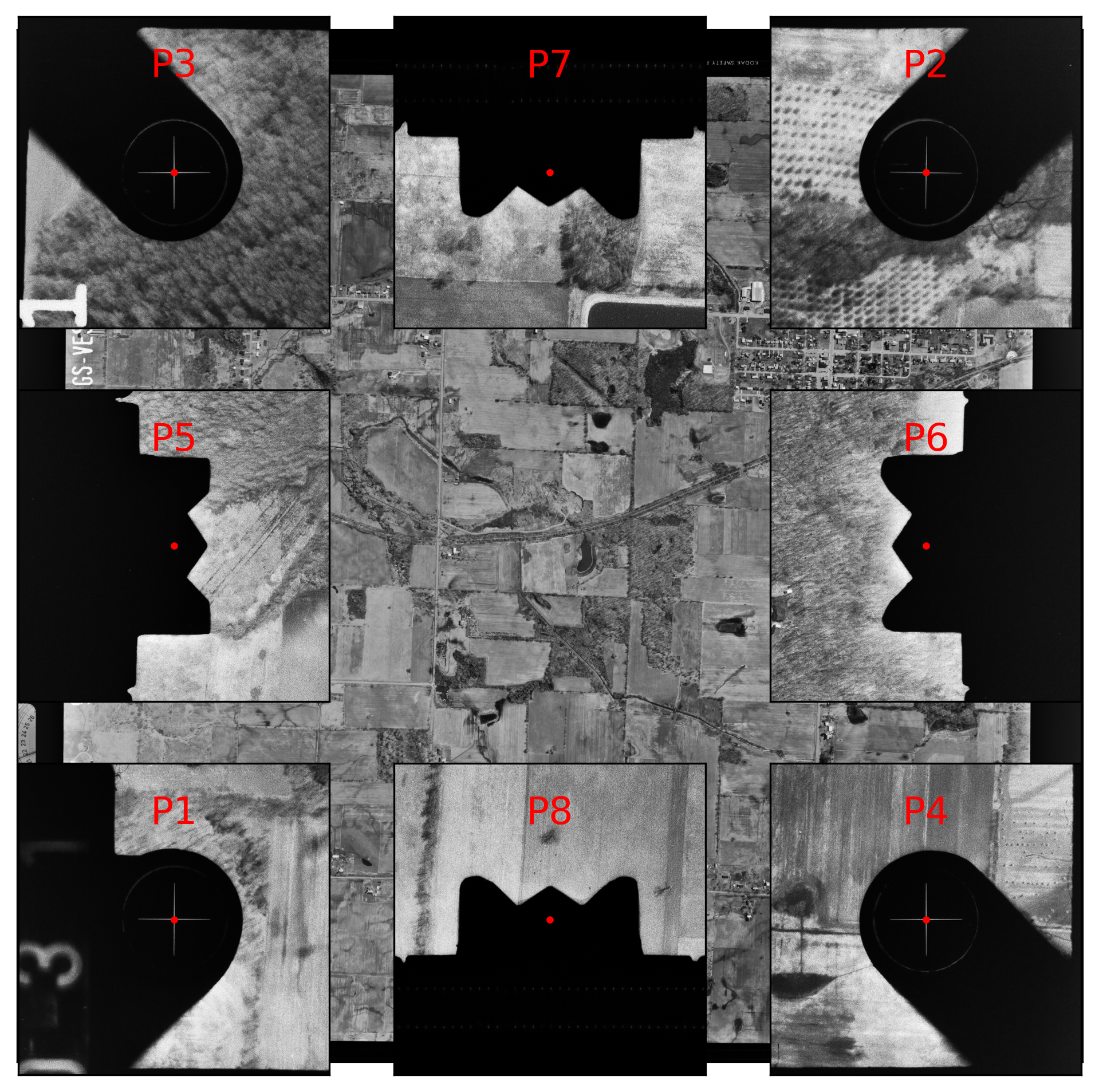
Marker Separation (n = 41 reports)
markers |
mean |
median |
|---|---|---|
P5 - P6 |
225.994 ± 0.016 |
225.995 |
P7 - P8 |
225.993 ± 0.011 |
225.994 |
P1 - P2 |
295.665 ± 4.064 |
294.018 |
P3 - P4 |
295.702 ± 4.062 |
294.027 |
Marker Location (n = 33 reports)
name |
x |
y |
angle |
|---|---|---|---|
P1 |
8.471 ± 1.590 |
217.527 ± 1.588 |
225.001 |
P2 |
217.521 ± 1.593 |
8.470 ± 1.592 |
45.001 |
P3 |
8.464 ± 1.590 |
8.473 ± 1.593 |
135.002 |
P4 |
217.528 ± 1.591 |
217.527 ± 1.588 |
315.001 |
P5 |
0.000 ± 0.010 |
112.998 ± 0.013 |
179.999 |
P6 |
225.992 ± 0.018 |
112.991 ± 0.012 |
0.004 |
P7 |
112.993 ± 0.013 |
0.000 ± 0.012 |
90.002 |
P8 |
113.002 ± 0.014 |
225.993 ± 0.009 |
270.003 |
Note
The coordinates for P5-P8 above correspond to the center of the small dot near the tip of the fiducial marker.